
Wednesday, September 23, 2020 – Golf Carts
- Mary Reed

- Sep 24, 2020
- 12 min read

I always start walking around 6:30 in the morning. In the summer it was still daylight then, but now it is dark. I am fortunate to live near Vitruvian Park which has good lighting. However, this morning I walk away from Vitruvian Park to the trail that encircles the Brookhaven College campus. It is not as well lit. I am lost in my early morning thoughts, still trying to wake up when a set of headlights comes barreling toward me. I am on a walking trail, so it can’t be a car. There are two headlights, so it can’t be a motorcycle. I jump off the trail into the grass. It is a golf cart. Apparently, groundskeepers work in the dark.
I have ridden on a golf cart at the Dallas Arboretum botanical garden with others who were tired of walking. It is a service provided by the 66-acre estate. Several years ago I took advantage of a retirement home village promotion and paid a minimal amount for a two-night stay in a 3-bedroom, 2-bath house that included two free meals, a golf lesson and free use of a golf cart. Of course, I had to listen to the sales spiel, but I loved driving the golf cart all over. It was so lightweight and quiet. There was a gentle breeze blowing for most of that weekend. It was delightful.

According to Wikipedia, a golf cart — called golf car in ANSI standard Z130.1, since "carts" are not self-propelled — is a small vehicle designed originally to carry two golfers and their golf clubs around a golf course or on desert trails with less effort than walking.
Golf carts come in a wide range of formats and are more generally used to convey small numbers of passengers short distances at speeds less than 15 mph. They are generally around 4 feet wide × 8 feet long × 6 feet high and weigh 900 to 1,000 pounds. Most are powered by 4-stroke engines.
The price of a golf cart can range anywhere from under $1,000 to well over $20,000 per cart, depending on several factors. These factors may include whether or not a fleet of carts is being purchased for a golf course or a country club, for example, and whether the carts are new or used. Other factors may include options such as equipment requirements and how many people the cart is meant to transport. With the rise in popularity of golf carts, many golf clubs or country clubs offer storage and energy options to golf cart owners. This has led to the modification of golf carts to suit use at a particular golf course. Typical modifications include windshields, ball cleaners, cooler trays, upgraded motor or speed controller — to increase speed and/or torque and lift kits.

Originally golf carts were only electrically powered, but in time gasoline-powered variants appeared. The electric variety is now used in many communities where their lack of pollutant, lack of noise and safety for pedestrians and other carts — due to slow speeds — are beneficial. When purpose-built for general transportation these are called Neighborhood Electric Vehicles or NEVs, but with various operating limitations such as top speed and heavy regulation on which type of streets these types of carts are permitted to be used.
The minimum age to drive a golf cart is 13 in Georgia, Alabama, California, Kansas, Kentucky, Rhode Island, Vermont, and South Carolina. Other U.S. states, such as Florida, have a minimum age of 14–15 years.

History
Reportedly, the first use of a motorized cart on a golf course was by J.K. Wadley of Texarkana, Texas/Arkansas, who saw a three-wheeled electric cart being used in Los Angeles to transport senior citizens to the grocery store. Later, he purchased a cart and found that it worked poorly on a golf course. The first electric golf cart was custom-made in 1932, but did not gain widespread acceptance. In the 1930s until the 1950s the most widespread use of golf carts was for those with disabilities who could not walk far. By the mid 1950s the golf cart had gained wide acceptance with golfers, with several manufacturers — e.g., Victor Adding Machine Co. and Sears Roebuck — producing various models. Most were electric.
Merle Williams of Long Beach, California was an early innovator of the electric golf cart. He started with knowledge gained from production of electric cars due to World War II gasoline rationing. In 1951 his Marketeer Co. began production of an electric golf cart in Redlands, California. E-Z-Go began producing golf cars in 1954, Cushman in 1955, Club Car in 1958, Taylor-Dunn in 1961, Harley-Davidson in 1963, Melex in 1971, Yamaha Golf Car in 1979 and CT&T in 2002.
Max Walker created the first gasoline-powered golf cart "The Walker Executive" in 1957. This three-wheeled vehicle was shaped with a vespa-style front end and — like any golf cart — carried two passengers and golf bags.

In 1963 the Harley-Davidson Motor Co. began producing golf carts. Over the years it manufactured and distributed thousands of three- and four-wheeled gasoline-powered and electric vehicles that are still highly sought after. The iconic three-wheeled cart — with either a steering wheel or a tiller-based steering control — boasted a reversible two-stroke engine similar to one used today in some high-end snowmobiles. (The engine runs clockwise in forward mode.) Harley-Davidson sold the production of golf carts to American Machine and Foundry Co., who in turn sold production to Columbia Par Car. Many of these units survive today, and are the prized possessions of proud owners, restorers and collectors worldwide.

Adaptive golf carts
New technology such as the SoloRider, an adaptive golf cart designed for a single user, is allowing disabled persons access to the golf course and the game itself. The cart’s seat swivels around, extends to an upright position and allows the golfer to stand upright, be supported and swing using both hands.

Extreme golf cart
Golf carts are now taking on an extreme nature, being highly modified from their original configuration to perform similar to the growing popularity of the Side by Side. Modifications as minor as suspension upgrades are commonplace, while entire redesigns may include axles and an engine from a full-size automobile. Solar-powered golf carts are an alternative to gas or regular charged electric golf cart. While this technology is still new and not as efficient as gas or electric, it is becoming more and more popular. In 2014, citEcar built and tested a solar-powered street-legal golf cart that will travel 105 miles on a single charge.

One of the most recent developments in golf cart technology is the GolfBoard, a golf cart that is inspired by the skateboard. The GolfBoard is driven by front and back gear boxes providing power to all four wheels. The golfer controls the cart in a standing upright position as if riding a skateboard, leaning left or right to make turns. The GolfBoard has been well received by the golfing community, as it speeds up play and — according to the manufacturers — has up to 75% less impact on turf than traditional golf carts. In 2014 the GolfBoard was voted the Best New Product at the PGA Show.
Golf cart communities
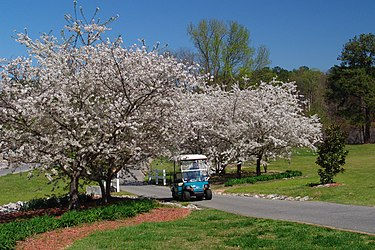
Peachtree City, Georgia has many miles of golf cart paths that link the city together. Children aged twelve or over may operate a cart on Peachtree City cart paths with a parent, grandparent or guardian in the front seat. Unaccompanied 15-year-olds with valid Georgia learner's permits are allowed to operate golf carts alone. Golf cart travel is used by a great majority of the community, especially among high school students. McIntosh High School and Starr’s Mill High School have student golf cart parking lots on their campuses.
On islands such as Santa Catalina Island, California; Bald Head Island, North Carolina; North Captiva Island, Florida; and Hamilton Island, Queensland, Australia, motor vehicles are sometimes restricted and residents use golf carts instead.
The Villages, Florida, a retirement community of over 70,000 people, has an extensive golf cart trail system — estimated at around 100 miles — and also allows golf carts on many streets. It is the most popular form of transportation in this community.
On the tropical islands of Belize golf carts are a major form of road transport and can be rented by tourists.

The residential community of Discovery Bay, Hong Kong does not allow the use of private vehicles apart from a fleet of 520 golf carts, excluding the ones operating exclusively in the golf or marina clubs. The remainder of the 20,000 residents rely on a mixture of shuttle buses and hire cars to travel around the township. Residents require a special license for golf carts, the number of which has been capped to 500 by the Transportation Department. The demand for motorized transportation in Discovery Bay — offset by a supply crunch — has catapulted the modest golf cart to luxury vehicle status.
The Palm Springs area in California contains multiple golf cart communities including PGA West, The Madison Club, The Hideaway and many more. The PGA Tour is held at PGA West every January.

Accidents and injuries
Along with the rising frequency of golf cart crashes, the number of golf-cart-related injuries has increased significantly over the last decade. A study conducted by researchers in the Center for Injury Research and Policy of The Research Institute at the Nationwide Children’s Hospital found that the number of golf cart-related injuries rose 132% during the 17-year study period. According to the study, published in the July 2008 issue of the Amrican Journal of Preventive Medicine, there were an estimated 148,000 golf cart-related injuries between 1990 and 2006, ranging from an estimated 5,770 cases in 1990 to approximately 13,411 cases in 2006. More than 30% of golf cart-related injuries involved children under the age of 16.
The most common type of injury was soft tissue damage, usually just bruises, followed by fractures, constituting 22.3% of the cases, and lacerations, accounting for 15.5% of injuries. Other types of injuries include concussions, internal injuries, subdural hematoma, spinal cord injury or acute respiratory compromise. While rare, a few cases had severe outcomes: four fatalities, two paraplegic and one quadriplegic injuries have been documented.

Some of the main causes of injury related to golf cart accidents included cart overturn, falling/jumping from a moving golf cart, collision with another vehicle or stationary object, struck/run over by a cart, getting into or out of a moving cart. Out of all these, "falling or jumping from a golf cart" was the most common cause of injury for both adults and children.
One contributing reason is that current golf cart safety features are insufficient to prevent passenger falls or ejection. Golf carts moving at speeds as low as 11 miles per hour could readily eject a passenger during a turn. Furthermore, rear-facing golf cart seats are associated with high rates of passenger ejection during fast acceleration, and most standard or stock golf carts do not have brakes on all four wheels — typically brakes are only on the rear wheels, thus sharply limiting their braking power.
Golf cart injuries are also commonly found in desert areas e.g., Johnson Valley, California. Driving golf carts on bumpy dirt trails, along cliffs and down rocky trails — that should only be traversed using 4-wheel-drive vehicles — can all lead to injuries.
According to Victor Omega’s March 6, 2018 article “25 of the Sickest Customized Golf Carts” at hotcars.com, below are a few examples of golf cart owners who got carried away.

Dark Knight Golf Cart
This golf cart was definitely inspired by the movie “Dark Knight” and could be one of Batman's automobiles. The golf cart is currently on sale for $17,500, which might be on the higher side — but not to Batman fans. What makes it unique from the other golf carts on the list is that it has six wheels, and you can enclose it completely should you wish to. The design has to be realistic if you want to sell it to Batman fans. They know they'll need protection from golf balls flying around. It has a top speed of 38 mph and is powered by a 6 hp battery-powered motor. You may not be the savior of Gotham, but you're still a hero who saves the environment.

1956 Ford Golf Cart
The ’56 Ford Golf Cart rocks distinctive features that make it resemble the original vehicle. The wrap-around shield is something that was unique with the ‘56 model and has been incorporated into this golf cart. We have to give credit to the guys who created this golf cart because they've given it a unique design compared to the original. The inlaid cherry wood design has been consistent, even with this golf cart. The shining 17-inch wheels make it look like a real car. The leather seats make for a comfortable ride, and there's no better color that could've been used for the exterior. Just like most golf carts on the list, the only thing lacking is a roof.

Hummer Golf Cart
The original Hummer truck might've been a failure, but you can't say the same for the golf cart. Not a lot of was expected from it, but the exterior design had to be spot on. There are several Hummer golf carts on the market for sale, depending on the model.
There are Hummer golf carts that can fit four people, which make them ideal for family fun day. Hummer drivers are notorious for attracting tickets, but you won't have to worry about that since you'll be driving it mainly on the golf course. You can also drive it in your neighborhood with the kids in the back. It's a fun to own such a golf cart because of the seating capacity.

Bob Hope Golf Cart
Bob Hope was one of the funniest comedians to have ever lived. The golf cart was created by George Barris, who passed away in 2015 and was a well-known figure in the golfing community. He was seen as the pioneer of the alternative golf cart, and there wouldn't have been such amazing custom modifications if it weren't for him. The luxury cart had everything you'd need from a TV to a radio console. The long, pointed nose was for comical relief and was something that would make anyone on the road laugh. The Bob Hope Golf Cart was sold at auction in 2013, the proceeds going to charity.

1955 Ford Fairlane Golf Cart
The Ford Fairlane first hit the market in 1955, which was a symbolic year for the car manufacturer. This rare vehicle came in 16 different colors when it launched, and we can say that the golf cart is a fair representation of the rich history of the ’55 Ford Fairlane. The golf cart would've been a little bigger so as to give it a more realistic look.
The parts have been resized perfectly, as the original Ford had so many curves, and it would need mastery to get it right with the exterior design. The original steering wheel makes it look authentic, but it could also use a roof.

UPS Golf Cart
It's always good for a company to be versatile, especially when faced with insurmountable challenges. This is exactly what this company did. Instead of unnecessary vehicles to do deliveries, they significantly cut the costs by modifying golf carts. It might not be the ideal situation for some people, but it does make practical sense if you deal with deliveries, and every estate can have one of the golf carts. They've even designated parking spots, which shows how they're essential to the company. The design is still good, despite the golf carts being created with the primary purpose of delivery. They're not far off from the original — especially when it comes to the presentation.

Hydra Gator Amphibious Golf Cart
This has to be the most expensive golf cart on the list at $60,000. The name is enough to tell you the capabilities of the golf cart. There's nothing as bad for a player as losing a golf ball in the water. This amphibious golf cart will get you to places where no normal one dares to reach.
It has a diesel-electric engine with twin marine motors, which are enough to make it go at 7 mph on water. It has a 4-wheel-drive system for land driving, which you can't get in the majority of the golf carts. There are so many situations where this golf cart might be more practical than normal cars, but the price tag is bound to keep a lot of people away.

Winnebago Golf Cart
This is one of the golf carts you could say looks better than the original vehicle when it comes to the design. There's a lot you could improve on when you look at the exterior of the recreational vehicle. It seems that the designers were more focused on the inside than how it looked from the outside.
They've included all-terrain tires to make it look more interesting. The grille is more beautifully designed compared to the RV. There's more than enough space for golf clubs, and you can even put an ice-cream machine back there in case it gets too hot on the golf course. You can use also use it for light transportation in your neighborhood.

Monster Truck Golf Cart
You can never underestimate the levels of human creativity and ingenuity. This monster truck golf cart is the perfect example of engineering at its finest. I'm assuming the owner has to be a tall guy because it can be a big challenge trying to get into the driver's seat. It might come in handy in the golf course because you see can everything from a vantage point. You can decide to take this monster off-road just to have a feel for how it can perform. The suspension looks strong enough to handle anything thrown at it. This is a golf cart you'd want to be using on a daily basis — as it looks dangerous — and it might take a lot of time climbing into, which wouldn't be ideal in a golf course situation.

Military Jeep Golf Cart
Military vehicles have always been a marvel to civilians. Their rugged look and performance make them have an edge over normal vehicles. This is the same reason why some people would want to create a golf cart with military characteristics.
This one looks more like a jeep, given the fact that a lot of them are used by militaries around the world. The inspiration for this particular golf cart must've been drawn from the Willys Army Jeep, which was popularly used in World War I. The thing with golf cart customizations is you're not limited with what you can create. This jeep golf cart has a top speed of 23 mph, which is decent, as the Willys Jeep could manage twice the speed.

Studebaker V8 Golf Cart
This is one of the most powerful golf carts in the world. You know it's more than love for the golf carts when the owner decides to include a V8 engine in such a tiny automobile. There's no way on Earth the humongous engine could've fit under the hood, and that's why the creators had to leave it exposed. This presents the challenge of visibility. On one hand, you have this monster of an engine that can spruce up your speed, and on the other hand, you can't really see where you're going, so you're forced to drive slowly. The guys who came up with this needs a solution on how he can go about the challenge. Otherwise, the vehicle will just be a tourist attraction with very limited functionality.


I just now figured out how to respond to comments. Kept trying to do it on the laptop & got nothing. Using the Wix app on my phone works! give credit in the article. The first part of it was from Wikipedia. The second part was from an article at hotcars.com. I just Google “weird golf carts” and see what comes up.
Where do you get this stuff?