
Tuesday, June 23, 2020 – Music Man
- Mary Reed

- Jun 23, 2020
- 8 min read

It is 6:30 a.m., the time of day when birds’ voices are the loudest — pure and clear in the early morning air with no other sounds to interrupt them. The constant “Cheep! Cheep! Cheep!” reminds me of a song from the popular musical Music Man. It is a scene when the gossipy women of the town are discussing Marian Paroo, the local librarian. Some of the “Pick a Little, Talk a Little” lyrics are:
Pick a little, talk a little, pick a little, talk a little Cheep, cheep, cheep, cheep, cheep, cheep, cheep, cheep Cheep, cheep, cheep, cheep, cheep, cheep, cheep, cheep
Cheep, cheep, cheep, cheep, cheep, cheep, cheep, cheep
Pick a little, talk a little, pick a little, talk a little Pick a little, talk a little, cheep!
Here’s a rendition of the song from the film adaptation:

Background
According to Wikipedia, Meredith Willson was inspired by his boyhood in Mason City, Iowa, to write and compose his first musical, The Music Man. He began developing this theme in his 1948 memoir, “And There I Stood With My Piccolo.” It took him some eight years and 30 revisions to complete the musical, for which he wrote more than 40 songs. He first approached producers Cy Feuer and Ernest Martin for a television special, and then Metro-Goldwyn-Mayer producer Jesse L. Lasky. After these and other unsuccessful attempts, he invited Franklin Lacey to help him edit and simplify the libretto. At this time, Willson considered eliminating a long piece of dialogue about the serious trouble facing River City parents. He realized it sounded like a lyric, and transformed it into the patter song (a fast tempo with a rapid succession of rhythmic patterns in which each syllable of text corresponds to one note, a staple of comic opera — especially Gilbert and Sullivan) “Ya Got Trouble.” He wrote about his trials and tribulations in getting the show to Broadway in his book “But He Doesn't Know the Territory.”

The character Marian Paroo was inspired by Marian Seeley of Provo, Utah, who met Willson during World War II, when she was a medical records librarian. In the original production and the film, the school board was played by the 1950 International Quartet Champions of the Society for the Preservation and Encouragement of Barber Shop Quartet Singing in America, the Buffalo Bills. Robert Preston claimed that he got the role of Harold Hill despite his limited singing range because when he went to audition, they were having the men sing "Trouble." The producers felt it would be the most difficult song to sing, but with his acting background, it was the easiest for Preston.
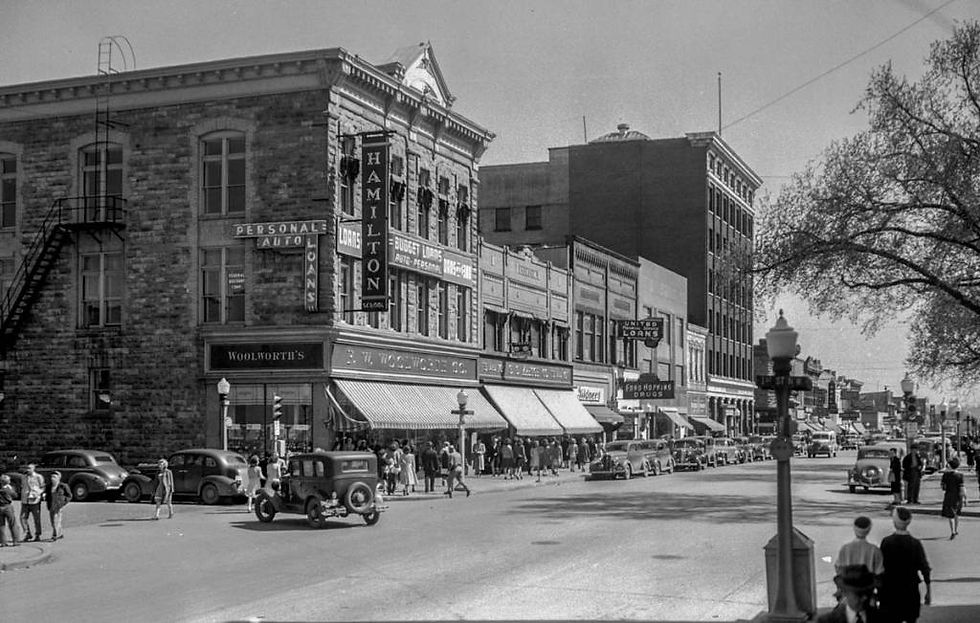
According to Noel Katz’s article “The Music Man” at musicalwriters.com, Meredith Willson, best known as a conductor, took many years to write his first musical, “The Music Man.” He started with two ideas: he wanted to create a nostalgic piece about the joys of growing up in the Midwest, and he wanted to write a show about a child with autism. The first idea is workable. The second idea was disastrous. Nobody in the 1950s would have sat still for a show about such a depressing subject.

They would today. Extremely tragic musicals like “Miss Saigon,” “Evita” and, most obviously, “Les Miserables” have created a new audience for joyless sobfests with bleak finales. Willson, fortunately, was part of the tradition in which music amplifies happy moments, celebrates, and finds the pleasure in ordinary as well as extraordinary things. So, he had to change the autism idea. The act of making that change gave him a theme for his show.

Commentary
According to Katz, “The Music Man” is all about transformation. Most often, the traveling huckster Harold Hill is an instrument of change. He takes a sleepy and rude town and makes it an energetic, musical and positive place. He takes a shy, stuttering boy (the replacement for the autistic character) and gives him a reason to smile, and to express himself without fear. A quartet of naysaying city officials becomes a harmony quartet. He meets a standoffish librarian and she falls very passionately in love with him. And she manages to reform him, which provides the climax of the plot.

Watching all this metamorphosis, we change a little ourselves. Professor Hill’s goal of selling band instruments and uniforms seems a little evil when we discover he’s ill-equipped to teach children how to play them. But that evil wondrously transmogrifies to a positive when we see what the attempt to learn music has done to everyone in the town.
Besides writing around a theme, Willson also takes great delight in pointing out that music is all around us if we listen carefully. The rattle of a train, the birdlike cackling of gossips, marbles on a library floor. While it may no longer be a hard-and-fast rule that musicals must celebrate, “The Music Man” is a paradigm of what can happen when a writer underscores the delight he finds in a particular world.

According to Wikipedia, in 1957, the show became a hit on Broadway, winning five Tony Awards, including Best Musical, and running for 1,375 performances. The cast album won the first Grammy Award for Best Musical Theater Album and spent 245 weeks on the Billboard charts. The show's success led to revivals, including a long-running 2000 Broadway revival, a popular 1962 film adaptation and a 2003 television adaptation. It is frequently produced by both professional and amateur theater companies.

Original Broadway production
After years of development, a change of producers, almost 40 songs — 22 were cut — and more than 40 drafts, the original Broadway production was produced by Kermit Bloomgarden, directed by Morton DaCosta and choreographed by Onna White. It opened on December 19, 1957, at the Majestic Theatre It remained there for nearly three years before transferring to The Broadway Theatre to complete its 1,375-performance run on April 15, 1961. The original cast included Robert Preston — who reprised his role in the 1962 screen adaptation — as Harold Hill, Barbara Cook as Marian, Eddie Hodges as Winthrop, Pert Kelton as Mrs. Paroo, Iggie Wolfington as Marcellus Washburn and David Burns as Mayor Shinn. Eddie Albert and Bert Parks each replaced Preston as Hill later in the run, and Paul Ford was a replacement for Mayor Shinn, later reprising the role in the film version. Howard Bay designed the sets. The musical won five Tony Awards, including Best Musical, winning in the same year that “West Side Story” was nominated for the award. Preston, Cook and Burns also won. Liza Redfield became the first woman to be the full-time conductor of a Broadway pit orchestra when she assumed the role of music director for the original production's final year of performances beginning in May 1960. The long-running US national tour opened in 1958, starring Forrest Tucker as Hill and Joan Weldon as Marian.

Planned Broadway revival in 2020
A Broadway revival is planned to begin previews on September 9, 2020, and open on October 15 at the Winter Garden Theatre, starring Hugh Jackman as Hill and Sutton Foster as Marian, produced by Scott Rudin and directed by Jerry Zaks with choreography by Warren Carlyle. Jefferson Mays and Joyne Houdyshell have been cast to play Mayor and Mrs. Shinn, with Shuler Hensley as Marcellus and Marie Mullen as Mrs. Paroo.

Setting and popular culture references
“The Music Man” is set in the fictional town of River City, Iowa, in 1912. The town is based in large part on Willson's birthplace, Mason City, Iowa, and many of the musical's characters are based on people that Willson observed in the town. The "river" in River City is probably the Mississippi River near Davenport, Iowa: the Rock Island conductor's announcing "River City, Iowa! Cigarettes illegal in this state" implies crossing the Mississippi from Rock Island, Illinois, into Iowa. The year 1912 was a time of relative innocence, as recalled in 1957 after two world wars, the Great Depression and the arrival of atomic weapons.

The musical includes numerous references to popular culture of the time. For example, in making his pitch, Harold Hill lists popular musicians and composers: Gilmore, Pat Conway, Guiseppe Creatore, W.C. Handy and John Philip Sousa. Some of the cultural references are anachronistic: "Trouble" contains references to both “Captain Billy’s Whiz Bang,” a monthly humor magazine that did not begin publication until October 1919, and the nonalcoholic “near-beer” Bevo, which was first brewed in 1916. In addition, Rafael Méndez — referred to by Hill as "O'Mendez," a great "Irish" trumpeter — was six years old in 1912.

Recordings
The first recording of “Till There Was You” was released before the original cast album version. Promotional copies of the 45 rpm single, Capitol P3847, were released on November 26, 1957, even before the Broadway production had premiered. Produced by Nelson Riddle, it featured his orchestra and 17-year-old vocalist Sue Raney.
The original cast recording was released by Capitol Records on January 20, 1958 in stereophonic & monaural versions and held the No. 1 spot on the Billboard charts for 12 weeks, remaining on the charts for a total of 245 weeks. The cast album was awarded "Best Original Cast Album" at the first Grammy Awards ceremony in 1958 and was inducted in 1998 as a Grammy Hall of Fame Award winner.

"Till There Was You" was covered by Anita Bryant in 1959 as a single for Carlton Records, reaching No. 30 on the Billboard Hot 100. ln 1963, The Beatles covered "Till There Was You" on their second LP “With the Beatles” — issued on “Meet the Beatles!” in the United States. Willson's widow later told The New York Times that his estate made more money from the royalties of the Beatles' recordings of "Till There Was You" than it did from the musical.
Below is a clip of the Beatles singing “Till There Was You” at their first U.S. appearance on the Ed Sullivan show Feb. 9, 1964.

Film adaptation
Although Robert Preston scored a great success in the original stage version of the show, he was not the first choice for the film version, mostly because he was not a major box office star. Bing Crosby was offered the part but turned it down. Jack L. Warner — who was notorious for wanting to film stage musicals with bigger stars than the ones who played the roles onstage — wanted Frank Sinatra for the role of Professor Hill, but Meredith Willson insisted upon Preston. Warner also offered the role of Hill to Cary Grant, but Grant declined saying, "Nobody could do that role as well as Bob Preston." Grant also reportedly told Warner that he (Grant) would not bother to see the film unless Preston was in it.
Unusual for a musical film at the time, Morton DaCosta, who had directed the stage version of the musical not only directed the film, but produced it as well, ensuring that the film was faithful to the show. In addition to Preston, the actress Pert Kelton as Mrs. Paroo and the Buffalo Bills as the school board also reprised their stage roles.
Several phrases were altered for the film, as the writers felt they were too obscurely Midwestern to appeal to a broader audience; the minced oath "Jeely kly!" is Tommy Djilas's catchphrase in the play, while in the film he exclaims, "Great honk!" The word "shipoopi" has no meaning and was concocted by Willson for the original Broadway show; it was left unchanged.
Shirley Jones was pregnant while the film was in production. When she and Robert Preston embraced during the footbridge scene, the fetus — who would be born on January 4 and would be named Patrick Cassidy — kicked Preston. The costume designers had to adjust her dresses several times to conceal her pregnancy.
For the final parade scene, Jack L. Warner selected the University of Southern California’s marching band, the Spirit of Troy. Many junior high school students from Southern California were also included, forming the majority of the band. It took approximately eight hours of shooting over two days to film the scene. All the musical instruments for the production were specially made for the film by the Olds Instrument Co. in Fullerton, California. The instruments were then refurbished and sold by Olds with no indication they were ever used in the film.


Comments