
Thursday, October 1, 2020 – Invention of the Light Bulb
- Mary Reed

- Oct 2, 2020
- 18 min read
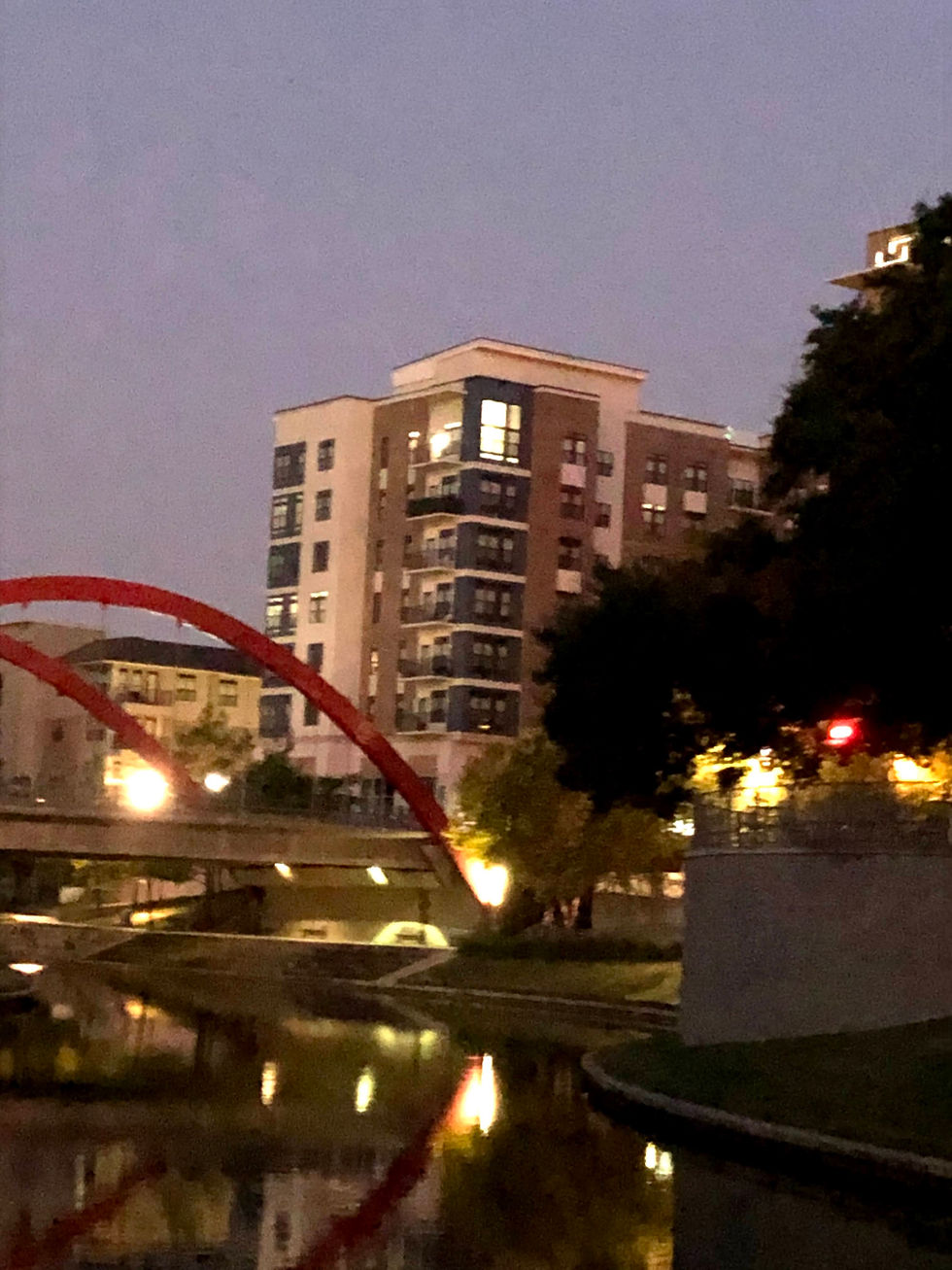
I am walking before sunrise. It is a weekday, so I always look at the Savoye2 Apartments to see who is up early, who has their lights on. Surely, there are many working people who are up by 6:30 a.m. I reason. Apparently not, all I see are a couple of apartments illuminated out of an entire building. To work from home, I guess you don’t have to be up that early. It made me wonder though — what was it like before you could turn on lights? How did people live before the invention of the light bulb? Let’s find out.

According to Wikipedia, An incandescent light bulb, incandescent lamp or incandescent light globe is an electric light with a wire filament heated until it glows. The filament is enclosed in a bulb to protect the filament from oxidation. Current is supplied to the filament by terminals or wires embedded in the glass. A bulb socket provides mechanical support and electrical connections.
Incandescent bulbs are manufactured in a wide range of sizes, light output, and voltage ratings, from 1.5 volts to about 300 volts. They require no external regulating equipment, have low manufacturing costs and work equally well on either alternating current or direct current. As a result, the incandescent bulb became widely used in household and commercial lighting, for portable lighting such as table lamps, car headlamps and flashlights, and for decorative and advertising lighting.
Incandescent bulbs are much less efficient than other types of electric lighting, converting less than 5% of the energy they use into visible light. The remaining energy is lost as heat. The lluminous efficacy of a typical incandescent bulb for 120 V operation is 16 lumens per watt, compared with 60 lm/W for a compact fluorescent bulb or 150 lm/W for some white LED lamps.

Some applications use the heat generated by the filament. Heat lamps are made for uses such as incubators, lava lamps and the Easy-Bake Oven toy. Quartz tube lamps are used for industrial processes such as paint curing or for space heating.
Incandescent bulbs typically have short lifetimes compared with other types of lighting; around 1,000 hours for home light bulbs versus typically 10,000 hours for compact fluorescents and 20,000–30,000 hours for lighting LEDs. Incandescent bulbs can be replaced by fluorescent lamps, high-intensity lamps, high-intensity discharge lamps and light-emmitting diode lamps LED fluorescent lamps, high-intensity discharge lamps and light-emitting diode lamps (LED). Some areas have implemented phasing out the use of incandescent light bulbs to reduce energy consumption.

History
Historians Robert Friedel and Paul Israel list 22 inventors of incandescent lamps prior to Joseph Swan and Thomas Edison. They conclude that Edison's version was able to outstrip the others because of a combination of three factors: an effective incandescent material, a higher vacuum than others were able to achieve — by use of the Sprengl pump — and a high resistance that made power distribution from a centralized source economically viable.
Historian Thomas Hughes has attributed Edison's success to his development of an entire, integrated system of electric lighting.
The lamp was a small component in his system of electric lighting, and no more critical to its effective functioning than the Edison Jumbo generator, the Edison main and feeder and the parallel-distribution system. Other inventors with generators and incandescent lamps — and with comparable ingenuity and excellence — have long been forgotten because their creators did not preside over their introduction in a system of lighting.
— Thomas P. Hughes, “In Technology at the Turning Point,” edited by W. B. Pickett

Pre-commercial research
In 1761, Ebenezer Kinnersley demonstrated heating a wire to incandescence.
In 1802, Humphry Davy used what he described as "a battery of immense size", consisting of 2,000 cells housed in the basement of the Royal Institution of Great Britain, to create an incandescent light by passing the current through a thin strip of platinum, chosen because the metal had an extremely high melting point. It was not bright enough nor did it last long enough to be practical, but it was the precedent behind the efforts of scores of experimenters over the next 75 years.
Over the first three-quarters of the 19th century, many experimenters worked with various combinations of platinum or iridium wires, carbon rods and evacuated or semi-evacuated enclosures. Many of these devices were demonstrated and some were patented.
In 1835, James Bowman Lindsay demonstrated a constant electric light at a public meeting in Dundee, Scotland. He stated that he could "read a book at a distance of one and a half feet." However, he did not develop the electric light any further.
In 1838, Belgian lithographer Marcellin Jobard invented an incandescent light bulb with a vacuum atmosphere using a carbon filament.

In 1840, British scientist Warren de la Rue enclosed a coiled platinum filament in a vacuum tube and passed an electric current through it. The design was based on the concept that the high melting point of platinum would allow it to operate at high temperatures and that the evacuated chamber would contain fewer gas molecules to react with the platinum — improving its longevity. Although a workable design, the cost of the platinum made it impractical for commercial use.
In 1841, Frederick de Moleyns of England was granted the first patent for an incandescent lamp, with a design using platinum wires contained within a vacuum bulb. He also used carbon.
In 1845, American John W. Starr patented an incandescent light bulb using carbon filaments. His invention was never produced commercially.
In 1851, Jean Eugène Robert-Houdin publicly demonstrated incandescent light bulbs on his estate in Blois, France. His light bulbs are on display in the museum of the Château de Blois.
In 1859, Moses G. Farmer built an electric incandescent light bulb using a platinum filament. He later patented a light bulb which was purchased by Thomas Edison.
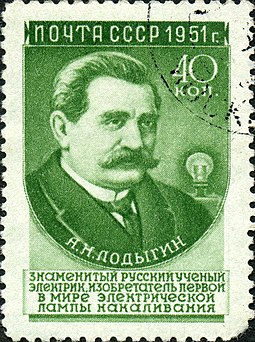
In 1872, Russian Alexander Lodygin invented an incandescent light bulb and obtained a Russian patent in 1874. He used as a burner two carbon rods of diminished section in a glass receiver, hermetically sealed, and filled with nitrogen, electrically arranged so that the current could be passed to the second carbon when the first had been consumed. Later he lived in the U.S., changed his name to Alexander de Lodyguine and applied and obtained patents for incandescent lamps having chromium, iridium, rhodium, ruthenium, osmimum, molybdenum and tungsten filaments, and a bulb using a molybdenum filament was demonstrated in Paris at the 1900 Exposition Universelle or world fair.
On 24 July 1874, a Canadian patent was filed by Henry Woodward and Mathew Evans for a lamp consisting of carbon rods mounted in a nitrogen-filled glass cylinder. They were unsuccessful at commercializing their lamp, and sold rights to their patent to Thomas Edison in 1879.
On 4 March 1880, just 5 month after Edison’s light bulb, Alessandro Cruto created his first incandescent lamp. He produced a filament by deposition of graphite on thin platinum filaments, by heating it with an electric current in the presence of gaseous ethyl alcohol. Heating this platinum at high temperatures leaves behind thin filaments platinum coated with pure graphite. By September 1881, he had achieved a successful version of this the first synthetic filament. The light bulb invented by Cruto, lasted 500 hours as opposed to the 40 of Edison’s original version. At the 1882 Munich Electrical Exhibition in Baveria, Germany Cruto's lamp was more efficient than Edison’s and produced a better, white light.
Heinrich Göbel in 1893 claimed he had designed the first incandescent light bulb in 1854, with a thin carbonized bamboo filament of high resistance, platinum lead-in wires in an all-glass envelope and a high vacuum. Judges of four courts raised doubts about the alleged Göbel anticipation, but there was never a decision in a final hearing due to the expiry date of Edison's patent. A research work published in 2007 concluded that the story of the Göbel lamps in the 1850s is a legend.

Commercialization
Joseph Swan (1828–1914) was a British physicist and chemist. In 1850, he began working with carbonized paper filaments in an evacuated glass bulb. By 1860, he was able to demonstrate a working device but the lack of a good vacuum and an adequate supply of electricity resulted in a short lifetime for the bulb and an inefficient source of light. By the mid-1870s better pumps had become available, and Swan returned to his experiments.
With the help of Charles Stearn — an expert on vacuum pumps — in 1878, Swan developed a method of processing that avoided the early bulb blackening. This received a British patent in 1880. On 18 December 1878, a lamp using a slender carbon rod was shown at a meeting of the Newcastle Chemical Society, and Swan gave a working demonstration at its meeting on January 17, 1879. It was also shown to 700 who attended a meeting of the Literary and Philosophical Society of Newcastle upon Tyne on February 3, 1879. These lamps used a carbon rod from an arc lamp rather than a slender filament. Thus they had low resistance and required very large conductors to supply the necessary current, so they were not commercially practical, although they did furnish a demonstration of the possibilities of incandescent lighting with relatively high vacuum, a carbon conductor, and platinum lead-in wires. This bulb lasted about 40 hours. Swan then turned his attention to producing a better carbon filament and the means of attaching its ends. He devised a method of treating cotton to produce”parchmentised thread” in the early 1880s and obtained British patent 4933 that same year. From this year he began installing light bulbs in homes and landmarks in England. His house, Underhill, Low Fll, Gateshead, was the first in the world to be lit by a lightbulb and also the first house in the world to be lit by hydroelectric power. In 1878 the home of Lord Armstrong at Cragside was also among the first houses to be lit by electricity. In the early 1880s, he had started his company. In 1881, the Savoy Theatre in the City of Westminister, London was lit by Swan incandescent lightbulbs, which was the first theatre and the first public building in the world to be lit entirely by electricity. The first street in the world to be lit by an incandescent lightbulb was Mosley Street, Newcastle upon Tyne, United Kingdom. It was lit by Joseph Swan's incandescent lamp on February 3, 1879.

Thomas Edison began serious research into developing a practical incandescent lamp in 1878. Edison filed his first patent application for "Improvement in Electric Lights" on October 14, 1878. After many experiments, first with carbon in the early 1880s and then with platinum and other metals, in the end Edison returned to a carbon filament. The first successful test was on October 22, 1879, and lasted 13.5 hours. Edison continued to improve this design and by November 4, 1879, filed for a US patent for an electric lamp using "a carbon filament or strip coiled and connected ... to platina contact wires." Although the patent described several ways of creating the carbon filament including using "cotton and linen thread, wood splints, papers coiled in various ways," Edison and his team later discovered that a carbonized bamboo filament could last more than 1200 hours. In 1880, the OrgonRailroad andNavigationCo. steamer, Columbia, became the first application for Edison's incandescent electric lamps. It was also the first ship to use a dynamo.
Albon Man, a New York lawyer, started Electro-Dynamic Light Co. in 1878 to exploit his patents and those of William Sawyer. Weeks later the United States Electric Lighting Co. was organized. This company didn't make its first commercial installation of incandescent lamps until the fall of 1880 at the Mercantile Safe Deposit Co. in New York City, about six months after the Edison incandescent lamps had been installed on the Columbia. Hiram S. Maxim was the chief engineer at the United States Electric Lighting Co.

Lewis Latimer, employed at the time by Edison, developed an improved method of heat-treating carbon filaments which reduced breakage and allowed them to be molded into novel shapes, such as the characteristic "M" shape of Maxim filaments. On January 17, 1882, Latimer received a patent for the "Process of Manufacturing Carbons", an improved method for the production of light bulb filaments, which was purchased by the United States Electric Light Co. Latimer patented other improvements such as a better way of attaching filaments to their wire supports.

In Britain, the Edison and Swan companies merged into the Edison and Swan United Electric Co. Ltd. — later known as Ediswan, and ultimately incorporated into Thorn Lighting Ltd. Edison was initially against this combination, but after Swan sued him and won, Edison was eventually forced to cooperate, and the merger was made. Eventually, Edison acquired all of Swan's interest in the company. Swan sold his U.S. patent rights to the Brush Electric Co. in June 1882.
The United States Patent Office gave a ruling October 8, 1883, that Edison's patents were based on the prior art of William Sawyer and were invalid. Litigation continued for a number of years. Eventually on October 6, 1889, a judge ruled that Edison's electric light improvement claim for "a filament of carbon of high resistance" was valid.
In 1896 Italian inventor Arturo Malignani (1865–1939) patented an evacuation method for mass production, which allowed obtaining economic bulbs lasting 800 hours. The patent was acquired by Edison in 1898.

In 1897, German physicist and chemist Walther Nernst developed the Nernst lamp, a form of incandescent lamp that used a ceramic globar and did not require enclosure in a vacuum or inert gas. Twice as efficient as carbon filament lamps, Nernst lamps were briefly popular until overtaken by lamps using metal filaments.

Metal filament, inert gas
In 1902, German multinational conglomerate Siemens developed a tantalum lamp filament that was more efficient than even graphitized carbon filaments since they could operate at higher temperature. Since tantalum metal has a lower resistivity than carbon, the tantalum lamp filament was quite long and required multiple internal supports. The metal filament gradually shortened in use; the filaments were installed with large slack loops. Lamps used for several hundred hours became quite fragile. Metal filaments had the property of breaking and re-welding, though this would usually decrease resistance and shorten the life of the filament. General Electric bought the rights to use tantalum filaments and produced them in the U.S. until 1913.

From 1898 to around 1905, osmium was also used as a lamp filament in Europe. The metal was so expensive that used broken lamps could be returned for partial credit. It could not be made for 110 V or 220 V so several lamps were wired in series for use on standard voltage circuits.

On 13 December 1904, Hungarian Sándor Just and Croatian Franjo Hanaman were granted a Hungarian patent for a tungsten filament lamp that lasted longer and gave brighter light than the carbon filament. Tungsten filament lamps were first marketed by the Hungarian company Tungsram in 1904. Filling a bulb with an inert gas such as argon or nitrogen slows down the evaporation of the tungsten filament, compared to operating it in a vacuum. This allows for greater temperatures and therefore greater efficacy with less reduction in filament life.
In 1906, William D. Coolidge developed a method of making "ductile tungsten" from sintered tungsten which could be made into filaments while working for General Electric Co. By 1911, General Electric had begun selling incandescent light bulbs with ductile tungsten wire.
In 1913, Irving Langmuir found that filling a lamp with inert gas instead of a vacuum resulted in twice the luminous efficacy and reduced bulb blackening.
In 1917, Burnie Lee Benbow was granted a patent for the coiled coil filament, in which a coiled filament is then itself wrapped into a coil by use of a mandrel. In 1921, Junichi Miura created the first double-coil bulb using a coiled coil tungsten filament while working for Hakunetsusha, a predecessor of Toshiba. At the time, machinery to mass-produce coiled coil filaments did not exist. Hakunetsusha developed a method to mass-produce coiled coil filaments by 1936.
Between 1924 and the outbreak of the Second World War, the Phoebus cartel attempted to fix prices and sales quotas for bulb manufacturers outside of North America.

In 1925, Marvin Pipkin, an American chemist, patented a process for frosting the inside of lamp bulbs without weakening them, and in 1947, he patented a process for coating the inside of lamps with silica.
In 1930, Hungarian Imre Bródy filled lamps with krypton gas rather than argon, and designed a process to obtain krypton from air. Production of krypton filled lamps based on his invention started at Ajka in 1937, in a factory co-designed by Polányi and Hungarian-born physicist Egon Orowan.
By 1964, improvements in efficiency and production of incandescent lamps had reduced the cost of providing a given quantity of light by a factor of 30, compared with the cost at introduction of Edison's lighting system.
Consumption of incandescent light bulbs grew rapidly in the U.S. In 1885, an estimated 300,000 general lighting service lamps were sold, all with carbon filaments. When tungsten filaments were introduced, about 50 million lamp sockets existed in the U.S. In 1914, 88.5 million lamps were used, (only 15% with carbon filaments), and by 1945, annual sales of lamps were 795 million — more than 5 lamps per person per year.

Color rendering
The spectrum of light produced by an incandescent lamp closely approximates that of a black body radiator at the same temperature. The basis for light sources used as the standard for color perception is a tungsten incandescent lamp operating at a defined temperature.
Light sources such as fluorescent lamps, high-intensity discharge lamps and LED lamps have higher luminous efficiency. These devices produce light by luminescence. Their light has bands of characteristic wavelengths, without the "tail" of invisible infrared emissions, instead of the continuous spectrum produced by a thermal source. By careful selection of fluorescent phosphor coatings or filters which modify the spectral distribution, the spectrum emitted can be tuned to mimic the appearance of incandescent sources, or other different color temperatures of white light. When used for tasks sensitive to color, such as motion picture lighting, these sources may require particular techniques to duplicate the appearance of incandescent lighting. Metamerism describes the effect of different light spectrum distributions on the perception of color.

Measures to ban use
Since incandescent light bulbs use more energy than alternatives such as compact fluorescent lamps and LED lamps, many governments have introduced measures to ban their use, by setting minimum efficacy standards higher than can be achieved by incandescent lamps. Measures to ban light bulbs have been implemented in the European Union, the United States, Russia, Brazil, Argentina, Canada and Australia, among others. In Europe, the European Community has calculated that the ban contributes 5 to 10 billion euros to the economy and saves 40 Terawatt-hour of electricity every year, translating in CO2 emission reductions of 15 million tons.
Objections to banning the use of incandescent light bulbs include the higher initial cost of alternatives and lower quality of light of fluorescent lamps. Some people have concerns about the health effects of fluorescent lamps.

Bulbs
1. Outline of Glass bulb
2. Low pressure inert gas (argon, nitrogen, krypton, xenon)
3. Tungsten filament
4. Contact wire (goes out of stem)
5. Contact wire (goes into stem)
6. Support wires (one end embedded in stem; conduct no current)
7. Stem (glass mount)
8. Contact wire (goes out of stem)
9. Cap (sleeve)
10. Insulation (vitrite)
11. Electrical contact
Most light bulbs have either clear or coated glass. Coated glass bulbs have kaolin clay blown in and electrostatically deposited on the interior of the bulb. The powder layer diffuses the light from the filament. Pigments may be added to the clay to adjust the color of the light emitted. Kaolin diffused bulbs are used extensively in interior lighting because of their comparatively gentle light. Other kinds of colored bulbs are also made, including the various colors used for "party bulbs," Christmas tree lights and other decorative lighting. These are created by coloring the glass with a dopant; which is often a metal like cobalt (blue) or chromium (green). Neodymium-containing glass is sometimes used to provide a more natural-appearing light.
The glass bulb of a general service lamp can reach temperatures between 392 and 500 °F. Lamps intended for high power operation or used for heating purposes will have envelopes made of hard glass or fused quartz.
If a light bulb envelope leaks, the hot tungsten filament reacts with air, yielding an aerosol of brown tungsten nitride, brown tungsten dioxide, violet-blue tungsten pentoxide and yellow tungsten trioxide that then deposits on the nearby surfaces or the bulb interior.

Gas fill
Most modern bulbs are filled with an inert gas to reduce evaporation of the filament and prevent its oxidation. The gas is at a pressure of about 70 kPa (0.7 atm).
The gas reduces evaporation of the filament, but the fill must be chosen carefully to avoid introducing significant heat losses. For these properties, chemical inertness and high atomic or molecular weight is desirable. The presence of gas molecules knocks the liberated tungsten atoms back to the filament, reducing its evaporation and allowing it to be operated at higher temperature without reducing its life — or, for operating at the same temperature, prolongs the filament life. On the other hand, the presence of the gas leads to heat loss from the filament — and therefore efficiency loss due to reduced incandescence — by heat conduction and heat convection.
Early lamps, and some small modern lamps used only a vacuum to protect the filament from oxygen. The vacuum increases evaporation of the filament but eliminates two modes of heat loss.

The most commonly used fills are:
· Vacuum, used in small lamps. Provides best thermal insulation of the filament but does not protect against its evaporation. Used also in larger lamps where the outer bulb surface temperature has to be limited.
· Argon (93%) and nitrogen (7%), where argon is used for its inertness, low thermal conductivity and low cost, and the nitrogen is added to increase the breakdown voltage and prevent arcing between parts of the filament.
· Nitrogen, used in some higher-power lamps, e.g. projection lamps, and where higher breakdown voltage is needed due to proximity of filament parts or lead-in wires.
· Krypton, which is more advantageous than argon due to its higher atomic weight and lower thermal conductivity — which also allows use of smaller bulbs — but its use is hindered by much higher cost, confining it mostly to smaller-size bulbs.
· Krypton mixed with xenon, where xenon improves the gas properties further due to its higher atomic weight. Its use is however limited by its very high cost. The improvements by using xenon are modest in comparison to its cost.
· Hydrogen, in special flashing lamps where rapid filament cooling is required; its high thermal conductivity is exploited here.
The gas fill must be free of traces of water, which greatly accelerates bulb blackening.
The gas layer close to the filament — called the Langmuir layer — is stagnant, with heat transfer occurring only by conduction. Only at some distance does convection occur to carry heat to the bulb's envelope.
The orientation of the filament influences efficiency. Gas flow parallel to the filament e.g., a vertically oriented bulb with vertical or axial filament, reduces convective losses.
The efficiency of the lamp increases with a larger filament diameter. Thin-filament, low-power bulbs benefit less from a fill gas, so are often only evacuated.

Early light bulbs with carbon filaments also used carbon monoxide, nitogen or mercury vapor. However, carbon filaments operate at lower temperatures than tungsten ones, so the effect of the fill gas was not significant as the heat losses offset any benefits.

Manufacturing
Early bulbs were laboriously assembled by hand. After automatic machinery was developed, the cost of bulbs fell. Until 1910, when Libbey's Westlake machine went into production, bulbs were generally produced by a team of three workers — two gatherers and a master gaffer — blowing the bulbs into wooden or cast-iron molds, coated with a paste. Around 150 bulbs per hour were produced by the hand-blowing process in the 1880s at Corning Glass Works.
The Westlake machine, developed by Libbey Glass, was based on an adaptation of the Owens-Libbey bottle-blowing machine. Corning Glass Works soon began developing competing automated bulb-blowing machines, the first of which to be used in production was the E-Machine. Corning continued developing automated bulb-production machines, installing the Ribbon Machine in 1926 in its Wellsboro, Pennsylvania, factory. The Ribbon Machine surpassed any previous attempts to automate bulb production and was used to produce incandescent bulbs into the 21st century. The inventor, William Woods, along with his colleague at Corning Glass Works, David E. Gray, had created a machine that by 1939 was turning out 1,000 bulbs per minute.
The Ribbon Machine works by passing a continuous ribbon of glass along a conveyor belt, heated in a furnace, and then blown by precisely aligned air nozzles through holes in the conveyor belt into molds. Thus, the glass bulbs or envelopes are created. A typical machine of this sort can produce anywhere from 50,000 to 120,000 bulbs per hour, depending on the size of the bulb. By the 1970s, 15 ribbon machines installed in factories around the world produced the entire supply of incandescent bulbs. The filament and its supports are assembled on a glass stem, which is then fused to the bulb. The air is pumped out of the bulb, and the evacuation tube in the stem press is sealed by a flame. The bulb is then inserted into the lamp base, and the whole assembly tested. The 2016 closing of Osram-Sylvania's Wellsboro, Pennsylvania plant meant that one of the last remaining ribbon machines in the United States was shut down.

Light output and lifetime
Incandescent lamps are very sensitive to changes in the supply voltage. These characteristics are of great practical and economic importance.
For a supply voltage V near the rated voltage of the lamp:
· Light output is approximately proportional to V 3.4
· Power consumption is approximately proportional to V 1.6
· Lifetime is approximately proportional to
V −16
· Color temperature is approximately proportional to V 0.42
A 5% reduction in voltage will double the life of the bulb but reduce its light output by about 16%. Long-life bulbs take advantage of this trade-off in applications such as traffic signal lamps. Since electric energy they use costs more than the cost of the bulb, general service lamps emphasize efficiency over long operating life. The objective is to minimize the cost of light, not the cost of lamps. Early bulbs had a life of up to 2500 hours, but in 1924 a cartel agreed to limit life to 1000 hours. When this was exposed in 1953, General Electric and other leading American manufacturers were banned from limiting the life.

The relationships above are valid for only a few percent change of voltage around standard rated conditions, but they indicate that a lamp operated at low voltage could last much longer than at rated voltage, albeit with greatly reduced light output. The "Centennial Light" is a light bulb that is accepted by the Guinness Book of World Records as having been burning almost continuously at a fire station in Livermore, California, since 1901. However, the bulb emits the equivalent light of a four-watt bulb. A similar story can be told of a 40-watt bulb in Texas that has been illuminated since September 21,1908. It once resided in an opera house where notable celebrities stopped to take in its glow and was moved to an area museum in 1977.
Flood lamps used for photographic lighting favor light output over life, with some lasting only two hours. The upper temperature limit for the filament is the melting point of the metal. Tungsten is the metal with the highest melting point, 6,191 °F. A 50-hour-life projection bulb, for instance, is designed to operate only 122 °F below that melting point. Such a lamp may achieve up to 22 lumens per watt, compared with 17.5 for a 750-hour general service lamp.
Lamps of the same power rating but designed for different voltages have different luminous efficacy. For example, a 100-watt, 1000 hour, 120-volt lamp will produce about 17.1 lumens per watt. A similar lamp designed for 230 V would produce only around 12.8 lumens per watt, and one designed for 30 volts — train lighting — would produce as much as 19.8 lumens per watt. Lower voltage lamps have a thicker filament, for the same power rating. They can run hotter for the same lifetime before the filament evaporates.
The wires used to support the filament make it mechanically stronger, but remove heat, creating another tradeoff between efficiency and long life. Many general-service 120-volt lamps use no additional support wires, but lamps designed for "rough service" or "vibration service" may have as many as five. Low-voltage lamps have filaments made of heavier wire and do not require additional support wires.
Very low voltages are inefficient, since the lead wires would conduct too much heat away from the filament, so the practical lower limit for incandescent lamps is 1.5 volts. Very long filaments for high voltages are fragile, and lamp bases become more difficult to insulate, so lamps for illumination are not made with rated voltages over 300 volts. Some infrared heating elements are made for higher voltages, but these use tubular bulbs with widely separated terminals.


Comments