
Sunday, September 14, 2020 – Cowboy Boots
- Mary Reed

- Sep 14, 2020
- 7 min read

I walk by a yard with a cowboy boot planter. The depiction of the cowboy boot in décor and other designs is common in Texas. People often expect everyone here to be wearing cowboy boots, just like when I lived in Oklahoma they expected to see herds of buffalo. Of course, neither is true. There are some buffalo herds in Oklahoma, but they are mostly confined to wildlife refuges. Cowboy boots in Texas are probably more prevalent in rural areas, although some big-city businessmen like to wear them to prove that they are from Texas. Those who participate in the professional rodeo circuit will ALWAYS wear cowboy boots. They can be a fashion statement for teenagers, along with 20- and 30-somethings. If you’re a country music singer, you will certainly wear cowboy boots. Fort Worth, Texas has a downtown stockyards entertainment area and twice-daily cattle drive where cowboy boot stores thrive.

According to Wikipedia, cowboy boots refer to a specific style of riding boot, historically worn by cowboys. They have a high heel that is traditionally made of stacked leather, rounded to pointed toe, high shaft and traditionally, no lacing. Cowboy boots are normally made from cowhide leather, which may be decoratively hand tooled, but are also sometimes made from "exotic" skins like alligator, snake, ostrich, lizard, eel, elephant, stingray, elk, buffalo, etc.
There are two basic styles of cowboy boots — western or classic and roper. The classic style is distinguished by a tall boot shaft, going to at least mid-calf, with an angled "cowboy" heel, usually over one inch high. A slightly lower, still angled "walking" heel is also common. The toe of western boots was originally rounded or squared in shape. The narrow pointed-toe design appeared in the early 1940s.
A newer design, the "roper" style, has a short boot shaft that stops above the ankle but before the middle of the calf, with a very low and squared-off "roper" heel, shaped to the sole of the boot, usually less than one inch high. Roper boots are usually made with rounded toes, but correlating with style changes in streetwear, styles with a squared toe are seen. The roper style is also manufactured in a lace-up design which often fits better around the ankle and is less likely to slip off, but lacing also creates safety issues for riding. They usually have some sort of decorative stitching.

History
Riding boots had been a part of equestrian life for centuries. Until the industrial age, boots were individually handmade in many different styles, depending on culture. Early cowboy boot designs, along with other cowboy accouterments, were also heavily influenced by the vaquero tradition that developed from a tradition that originated in Spain to the Americas, dating back to the early 16th century. Military boots designed for cavalry riders also had an influence. Mexican vaqueros probably developed a cowboy boot from the Spanish riding boots. The Mexican cowboy boots only came in three styles — rounded toe, pointed toe and tribal toe, while the Americans offer many more styles. Also, the idea of using skins on the boots came from Northern Mexico, as well as the colors; the colors imitate the color of Mexican ranches.
Later, the Industrial Revolution allowed some styles of boots to be mass-produced. One mass-produced boot style, the Wellington boot — a shorter but cavalry-oriented boot — was popular with cowboys in the U.S. until the 1860s.
During the cattle drive era of 1866–1884, the cowboy was not apt to ruin a good pair of dress boots while working, so some owned more decorative dress boots to wear in town. The basic style elements permeated even working boots and made the Wellington obsolete. Fashion magazines from 1850 and 1860 show the cowboy boot with top stitching, cutouts of geometric or other natural elements and underslung heel.

The American-style boot was taken up by bootmakers in the cattle ranching areas of Texas, Oklahoma and Kansas. Two of the best known early bootmakers of the era were Charles Hyer of Hyer Brothers Boots in Olathe, Kansas, and H.J. “Daddy Joe” Justin of Justin Boots in Spanish Fort, Texas and later Nocona, Texas. After Justin moved to Fort Worth where shipping was easier, the Nocona brand of cowboy boots was made by Enid Justin Stelzer — eldest daughter of H. J. Justin — who stayed in Nocona with her husband, and the couple continued the family business. After the couple divorced, the Olsen-Stelzer brand was started by Stelzer.
T.C. McInerney of Abilene, Kansas, also made the American-style cowboy boot. A picture of this boot is listed in an ad in the Abilene Weekly Chronicle on December 7, 1871.

According to the April 18, 2020 article “A Potted History of the Cowboy Boot” at historyofboots.blogspot.com, English Cavaliers took the style to extraordinary lengths wearing thigh high riding boots with Cuban heels. Once defeated by Oliver Cromwell, the Cavalier Stuarts immigrated in their droves to the New World. They took with them their boots, and many settled in the southern states forming the plantation class. After the Civil War many southerners migrated west to Texas taking with them their noble footwear. Standard cavalry issue during the American Civil War was the Wellington boot.

In 1815, Arthur Wellesley, First Duke of Wellington, defeated Napoleon Bonaparte at the Battle of Waterloo. The popular victor became a national icon and both men and women emulated his sartorial style by adopting his footwear. To make the boots easier to mass produce, the modern Wellington had a low-cut heel which was calf-high and not thigh-high.

Unfortunately, during the American Civil War unscrupulous contractors supplied below par footwear to the government and many of the cavalry boots were mass produced using reinforced cardboard. Climatic conditions took its tool and horse soldiers suffered deep cuts to their feet. A Chiropodist General to the U.S. cavalry was appointed at this time. Our lexicon was enriched with the word shoddy meaning manufacturers willing to compromise for profit. Many experts believe the final victory by the Union Army was in no small measure due to the superior footwear of their forces. There were few boot factories in the south and many of the Confederate Army fought barefoot.

During the American Indian Wars in the West circa 1865, the U.S. government issued new boots to the soldiers that used brass tacks to hold the leather soles to the uppers. As the soles wore down the tracks protruded through the bottom into the soldier’s feet. The government put together a committee to study the problem and suggested a solution. Their solution was to issue each soldier with a metal file to file down the points of the tacks as they pushed through the boot sole. This is thought to be the origin of the phrase “getting down to brass tacks.”

High heeled boots (4") — called saddle dandies — were popular by 1860s. The back of the heel sloped gently until the sole was no bigger than a quarter.
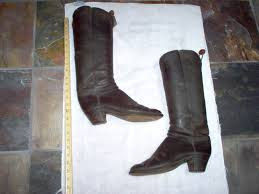
Drover, stovepipe and cattleman models were popular, and the leg of the boots rose at least 14 inches with many boots going thigh-high.

By the 1880s, the cowboy boot was beginning to emerge as a distinctive style. Starting life as a dress Wellington or full Wellington, the fashion merged with the hard-wearing lace up boot or packer, worn by drovers. Other influences included the Mexican riding boot called vaquero. Early cowboy boots had no ornamentation and for control in the saddle, the shoe portion was made so tight that walking was difficult and painful. Originally, both boots were made on the same last which necessitated the wearer having to break them in. Later, the three-piece military boot was incorporated and worn by Hollywood's cowboys.

In 1903, the first embroidered toe wrinkles started to appear. Cutout leather designs often in a star pattern were sometimes overlaid around the collars of the boot tops. Tejas or Napoleon-style boots with their peacock flair and ostentatious inlays were worn by Hollywood megastars like Tex Ritter (1905 -1974) and Tom Mix (1880 – 1940) during the 20s and 30s. At first, films were made in the eastern states, and the costumes were based on exaggerated clothing illustrated in cheap novels and comics. By the time the industry moved to California in 1914 and employed real cowboys, their actual clothes were considered too dull compared to the illusion.

Instead, actors wore highly decorated boots outside their trousers.

n 1914 Charlie Dunn— one of Texas's most famous bootmakers — produced a pair of boots trimmed with gold and inlaid with diamonds and rubies for a gambler. In 1923 boots made from kangaroo skins were available in the U.S. It is therefore somewhat surprising to think that today’s cowboy boots are really fantasy footwear fabricated by Hollywood and have little to do with the Wild West.

The Italian shoe designer Salvatore Ferragamo (1898- 1960) made boots for one of Cecil B. de Mille’s films. The director was so impressed he said, "The West would have been conquered earlier, if they had boots like these." The style caught on and thanks to Hollywood became popular around the world. Designs became more colorful and ornate, and fashion designers flocked to add to the range of boots available.

By the 1930s, cowboy boots were available with leather inlays depicting steer heads, stars, half-moons, dice diamonds, initials, ranch brands, hearts and butterflies. Bootmakers vied to outdo each other with colored leathers, stitching and exotic materials, decorating their boots with decks of cards, oil derricks, spider webs, prickly pear cacti and bucking broncos. The exotic cowboy boot remained popular and peaked in the mid-50s.
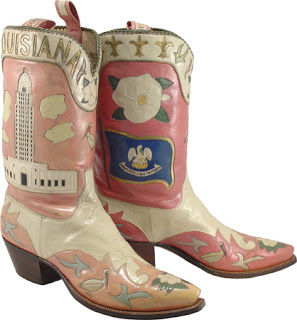
In the1940s the Lucchese Co. of Texas produced 48 pairs of boots to symbolize each of the states, featuring inlays of the state house and state flower, bird and flag.

In 1954, the design of cowboy boots changed to accommodate the growing sport of roping. At rodeos, competitors were required to bale off their mounts, then chase and tackle a strong calf. A lower heel and rounded toe was preferred. This style soon caught on with the audience and became the vogue.

The 60s brought an oil boom to the oil states which led to a subsequent economic upswing. Conservative Texans were more likely to drive a Cadillac than ride mustangs, therefore influencing the fashion for lower heeled boots.

By the 70s urban cowboys took to the dance floor, and the common work boot all but vanished. The new boots were less hardwiring and more high fashion. Today's styles cater for both with the traditional high heel and pointed toes for the posers and a lower heel, rounder toed boot with comfortable soles and laces for the real cowboy.

There has been a common bond among many of the modern U.S. Presidents and cowboy boots. Harry Truman (1948) ordered his from the famous bootmaker Tony Lama, establishing the "El Presidente" style — which in turn graced the feet of many other U.S. Presidents.


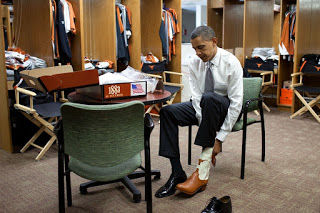

Things changed in the 2016 presidential election. Democratic nominee Hillary Clinton should by all accounts have won the election, but Donald J. Trump took the position despite losing the popular vote by nearly three million votes, winning the Electoral College vote 304 to 227. So, Hillary Clinton had the boots, but Donald Trump took his custom-made Italian shoes to the White House.


Thanks SO much for your kind comments. Very interesting about Enid Justin.
Mary,
You continue to outdo yourself. I have had boots all my life, and still hold out for the dream of custom-made boots. Alas, I have never felt like I could spend that kind of money. Maybe someday. I do have Lucchesse's and Tecovas, and I've had Tony Lama and others.
My grandmother's best friend growing up in Spanish Fort was Enid Justin. As I recall, she was a delightful lady, and you'd never know she was rich or famous.
I read your work almost every day, as you generally have topics that interest me. I have never been disappointed.