
Sunday, December 6, 2020 - Saxophones
- Mary Reed

- Dec 13, 2020
- 13 min read

I walk by a house that has a sign out front with Hayden’s name on it and the words BAND and Saxophone. When I was in the band, there were no signs with my name on it, along with the instruments I played. Proclaiming a student’s accomplishment in sports is much more common. I have seen many signs with the student’s name and the particular sport he or she excels in — golf, soccer, swimming, etc. But band!?! All I can say is, it’s about time. Why should athletes get all the glory? Musicians deserve praise too. Indeed, scholars should also be recognized. If a student excels in a certain subject, why not print his or her name on a sign along with Math, History, Literature, etc.? But I digress. I played the clarinet in the junior high and high school band — even took private lessons from a music professor in the university town I lived in. In junior high, there was also a stage band. There, I played the alto saxophone. It felt cool to wear the same vest as everyone in the band and play jazzy tunes for an audience. I have always loved the sexy sound of a saxophone. Let’s learn more about it.

History
Early development and adoption
The saxophone was designed around 1840 by Adolphe Sax, a Belgian instrument maker, flautist and clarinetist. Born in Dinant and originally based in Brussels, he moved to Paris in 1842 to establish his musical instrument business. Before working on the saxophone, he made several improvements to the bass clarinet by improving its keywork and acoustics and extending its lower range. Sax was also a maker of the ophicleide, a large conical brass instrument in the bass register with keys similar to a woodwind instrument. His experience with these two instruments allowed him to develop the skills and technologies needed to make the first saxophones.
As an outgrowth of his work improving the bass clarinet, Sax began developing an instrument with the projection of a brass instrument and the agility of a woodwind. He wanted it to overblow at the octave — unlike the clarinet, which rises in pitch by a twelfth when overblown. An instrument that overblows at the octave has identical fingering for both registers.

Sax created an instrument with a single-reed mouthpiece and conical brass body. Having constructed saxophones in several sizes in the early 1840s, he applied for and received a 15-year patent for the instrument on June 28, 1846. The patent encompassed 14 versions of the fundamental design, split into two categories of seven instruments each, ranging from sopranino to contrabass. A limited number of instruments in the series pitched in F and C were produced by Sax, but the series pitched in E♭ and B♭ quickly became the standard. All the instruments were given an initial written range from the B below the treble staff to the E♭ one half-step below the third ledger line above staff, giving each saxophone a range of two and a half octaves. Sax's patent expired in 1866. Thereafter, numerous other instrument manufacturers implemented their own improvements to the design and keywork.
Sax's original keywork — which was based on the Triebert system 3 oboe for the left hand and the Boehm clarinet for the right — was simplistic and made certain legato passages and wide intervals extremely difficult to finger; that system would later evolve with extra keys, linkage mechanisms and alternate fingerings to make some intervals less difficult.

Early in the development of the saxophone the upper keyed range was extended to E, then F above the staff; 1880s era sheet music for saxophone was written for the range of low B to F. In 1887 the Buffet-Crampon company obtained a patent for extending the bell and adding an extra key to extend the range downwards by one semitone to B♭. This extension is currently standard in most modern designs, with the notable exception of baritone saxophones further extended and keyed to low A. The upper range to F would remain the standard for nearly a century until the altissimo F♯ key became common on modern saxophones.

In the 1840s and 1850s, Sax's invention gained use in small classical ensembles — both all-saxophone and mixed — as a solo instrument and in French and British military bands. Saxophone method books were published and saxophone instruction was offered at conservatories in France, Switzerland, Belgium, Spain and Italy. By 1856 the French Garde Republicaine band included eight saxophones, making it the large ensemble that featured the instrument most prominently. The saxophone was used experimentally in orchestral scores, but never came into widespread use as an orchestral instrument. In 1853-54 the orchestra of Louis Antoine Jullien featured a soprano saxophone on a concert tour of the United States.

After an early period of interest and support from classical music communities in Europe, their interest in the instrument waned in the late 19th century. Saxophone teaching at the Paris Conservatory was suspended from 1870 to 1900, and classical saxophone repertoire stagnated during that period. But it was during this same period that the saxophone began to be promoted in the United States, largely through the efforts of Patrick Gilmore, leader of the 22 Regiment band, and Edward A. Lefebre, a Dutch emigre and saxophonist with family business associations with Sax. Lefebre settled in New York in early 1872 after he arrived as a clarinetist with a British opera company. Gilmore organized the World's Peace Jubilee and International Music Festival taking place in Boston that summer. The Garde Republicaine band performed, and Lefebre was a clarinetist with the Great Festival Orchestra for that event. In the fall of 1873 Gilmore was reorganizing the 22nd Regiment band under the influence of the Garde Republicaine band and recruited Lefebre, who had established a reputation in New York as a saxophonist over the previous year. Gilmore's band soon featured a soprano-alto-tenor-baritone saxophone section, which also performed as a quartet. The Gilmore-Lefebre association lasted until Gilmore's death in 1892, during which time Lefebre also performed in smaller ensembles of various sizes and instrumentation and worked with composers to increase light classical and popular repertoire for saxophone.

Lefebre's later promotional efforts were extremely significant in broadening adoption of the saxophone. Starting towards the end of the 1880s he consulted with the brass instrument manufacturer C.G. Conn to develop and start production of improved saxophones to replace the costly, scantly available and mechanically unreliable European instruments in the American market. The early 1890s saw regular production of saxophones commence at Conn and its offshoot Buescher Manufacturing Co., which dramatically increased availability of saxophones in the U.S. Lefebre worked with the music publisher Carl Fischer to distribute his transcriptions, arrangements and original works for saxophone and with the Conn Conservatory to further saxophone pedagogy in the U.S. Lefebre's associations with Conn and Fischer lasted into the first decade of the 20th century, and Fischer continued to publish new arrangements of Lefebre's works posthumously.

Early 20th century growth and development
While the saxophone remained marginal and regarded mainly as a novelty instrument in the classical music world, many new musical niches were established for it during the early decades of the 20th century. Its early use in vaudeville and ragtime bands around the turn of the century laid the groundwork for its use in dance orchestras and eventually jazz. As the market for saxophones grew in the U.S., the manufacturing industry grew; the Martin Band Instrument Co. started producing saxophones between 1905 and 1912, and the Cleveland Band Instrument Co. started producing saxophones under contract to the H.N. White Co. in 1916. The saxophone was promoted for the casual market with introduction of the C-soprano and C-melody — between alto and tenor — saxophones to play in key with pianos from the same sheet music. Production of such instruments stopped during the Great Depression. During the 1920s the saxophone came into use as a jazz instrument, fostered by the influences of the Fletcher Henderson Orchestra and the Duke Ellington Orchestra. Starting in the late 1920s and early 1930s, the modern era of classical saxophone was launched largely through the efforts of Marcel Mule and Sigurd Raschèr, and classical repertoire for the instrument expanded rapidly.

The use of the saxophone for more dynamic and more technically demanding styles of playing added incentive for improvements in keywork and acoustic design. Early saxophones had two separate octave keys operated by the left thumb to control the two octave vents required on alto and larger saxophones. A substantial advance in keywork around the turn of the century was the development of mechanisms by which the left thumb operates the two octave vents with a single octave key. Ergonomic design of keywork evolved rapidly during the 1920s and 1930s. The front F mechanism supporting alternate fingerings for high E and F, and stack-linked G♯ key action, became standard during the 1920s, followed by improvements to the left-hand table key mechanisms controlling the G♯ and bell keys. New bore designs during the 1920s and 1930s resulted from the quest for improved intonation, dynamic response and tonal qualities. The 1920s were also the era of design experiments such as the Buescher straight altos and tenors, King Saxello soprano, C.G. Conn mezzo-soprano saxophone keyed in F and Conn-O-Sax saxophone–English horn hybrid.

Modern saxophone emerges
The modern layout of the saxophone emerged during the 1930s and 1940s, first with right-side bell keys introduced by C.G. Conn on baritones, then by King on altos and tenors. The mechanics of the left-hand table were revolutionized by Selmer with its Balanced Action instruments in 1936, capitalizing on the right-side bell key layout. In 1948 Selmer introduced its Super Action saxophones with offset left and right-hand stack keys. Between 30 and 40 years after Selmer devised its final layout, it had been adopted for virtually every saxophone being produced — from student to professional models.
The high F♯ key was also first introduced as an option on the Balanced Action model, although it took several decades for it to gain acceptance because of perceived deleterious effects on intonation in its early implementations.

Uses in military bands and classical music
The saxophone first gained popularity in military bands. Although the instrument was initially ignored in Germany, French and Belgian military bands were quick to include the instrument in their ensembles. Most French and Belgian military bands incorporate at least a quartet of saxophones, comprising an E♭ baritone, B♭ tenor, E♭ alto and B♭ soprano. These four instruments have proved the most popular of all of Sax's creations, with the E♭ contrabass and B♭ bass usually considered impractically large and the E♭ sopranino insufficiently powerful. British military bands tend to include at minimum two saxophonists, on the alto and tenor.
The saxophone was introduced into the concert band, which usually calls for an E♭ alto saxophone, a B♭ tenor saxophone and an E♭ baritone saxophone. A concert band may include two altos, one tenor and one baritone. A B♭ soprano saxophone is also used, in which case it is played by the first alto saxophonist. A bass saxophone in B♭ is used in some concert band music — especially music by Percy Grainger.
Saxophones are used in chamber music, such as saxophone quartets and other chamber combinations of instruments. The classical saxophone quartet consists of a B♭ soprano saxophone, E♭ alto saxophone, B♭ tenor saxophone and E♭ baritone saxophone or SATB. On occasion, the soprano is replaced with a second alto sax; a few professional saxophone quartets have featured non-standard instrumentation, such as James Fei's Alto Quartet which has four altos.

There is a repertoire of classical compositions and arrangements for the SATB instrumentation dating back to the 19th century, particularly by French composers who knew Sax. However, the largest body of chamber works for saxophone are from the modern era of classical saxophone initiated by Marcel Mule in 1928. Sigurd Raschèr followed as a soloist in orchestral works, starting in 1931, and also figured prominently in development of modern classical saxophone repertoire. The Mule quartet is often considered the prototype for quartets due to the level of virtuosity demonstrated by its members and its central role in the development of modern quartet repertoire. However, organized quartets existed before Mule's ensemble, the prime example being the quartet headed by Edward A. Lefebre (1834–1911), which was a subset of Patrick Gilmore's 22nd Regiment band between 1873 and 1893.
In the 20th and 21st centuries, the saxophone found increased popularity in symphony orchestras. The instrument has also been used in opera and choral music. Musical theatre scores also can include parts for saxophone, sometimes doubling another woodwind or brass instrument.

In jazz and popular music
Coincident with the more widespread availability of saxophones in the U.S. around the turn of the century was the rise of ragtime music. The bands featuring the syncopated Latin- and African-American rhythmic influences of ragtime were an exciting new feature of the American cultural landscape and provided the groundwork for new styles of dancing. Two of the best known ragtime-playing brass bands with saxophones were those led by W.C. Handy and James R. Europe. Europe's 369th Infantry Regiment Band popularized ragtime in France during its 1918 tour. The rise of dance bands into the 1920s followed from the popularity of ragtime. The saxophone was also used in vaudeville entertainment during the same period. Ragtime, vaudeville and dance bands introduced much of the American public to the saxophone. Rudy Wiedoeft became the best known individual saxophone stylist and virtuoso during this period leading into the "saxophone craze" of the 1920s. Following it, the saxophone became featured in music as diverse as the "sweet" music of Paul Whiteman and Guy Lombardo, jazz, swing and large stage show bands.

The rise of the saxophone as a jazz instrument followed its widespread adoption in dance bands during the early 1920s. The Fletcher Henderson Orchestra, formed in 1923, featured arrangements to back up improvisation, bringing the first elements of jazz to the large dance band format. Following the innovations of the Fletcher Henderson Orchestra, the Duke Ellington Orchestra and Jean Goldkette’s Victor Recording Orchestra featured jazz solos with saxophones and other instruments. The association of dance bands with jazz would reach its peak with the swing music of the 1930s. The large show band format — influenced by the 1930s swing bands — would be used as backing for popular vocalists and stage shows in the post-World War II era and provided a foundation for big band jazz. Show bands with saxophone sections became a staple of television talk shows — such as the Tonight Show that featured bands led by Doc Severinsen and Branford Marsalis — and Las Vegas stage shows. The swing era fostered the later saxophone styles that permeated bebop and rhythm and blues in the early postwar era.

Coleman Hawkins established the tenor saxophone as a jazz solo instrument during his stint with Fletcher Henderson from 1923 to 1934. Hawkins' arpeggiated, rich-toned, vibrato-laden style was the main influence on swing era tenor players before Lester Young, and his influence continued with other big-toned tenor players into the era of modern jazz. Among the tenor players directly influenced by him were Chu Berry, Charlie Barnet, Tex Beneke, Ben Webster, Vido Musso, Herschel Evans, Buddy Tate and Don Byas. Hawkins' bandmate Benny Carter and Duke Ellington's alto saxophonist Johnny Hodges became influential on swing era alto styles, while Harry Carney brought the baritone saxophone to prominence with the Duke Ellington Orchestra. The New Orleans player Sidney Bechet gained recognition for playing the soprano saxophone during the 1920s, but the instrument did not come into wide use until the modern era of jazz.

As Chicago style jazz evolved from New Orleans jazz in the 1920s, one of its defining features was the addition of saxophones to the ensemble. The small Chicago ensembles offered more improvisational freedom than did the New Orleans or large band formats, fostering the innovations of saxophonists Jimmy Dorsey (alto), Frankie Trumbauer (c-melody), Bud Freeman (tenor) and Stump Evans (baritone). Dorsey and Trumbauer became important influences on tenor saxophonist Lester Young.
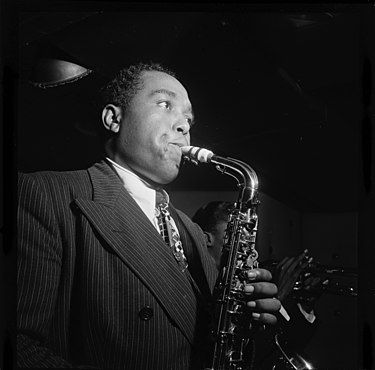
Lester Young's approach on tenor saxophone differed from Hawkins', emphasizing more melodic "linear" playing that wove in and out of the chordal structure and longer phrases that differed from those suggested by the tune. He used vibrato less, fitting it to the passage he was playing. His tone was smoother and darker than that of his 1930s contemporaries. Young's playing was a major influence on the modern jazz saxophonists Al Cohn, Stan Getz, Zoot Sims, Dexter Gordon, Wardell Gray, Lee Konitz, Warne Marsh, Charlie Parker and Art Pepper.
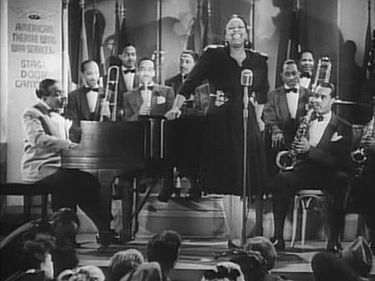
The influence of Lester Young with the Count Basie Orchestra in the late 1930s and the popularity of Hawkins' 1939 recording of "Body and Soul" marked the saxophone as an influence on jazz equal to the trumpet, which had been the defining instrument of jazz since its beginnings in New Orleans. But the greatest influence of the saxophone on jazz was to occur a few years later when alto saxophonist Charlie Parker became an icon of the bebop revolution that influenced generations of jazz musicians. The small-group format of bebop and post-bebop jazz ensembles gained ascendancy in the 1940s as musicians used the harmonic and melodic freedom pioneered by Parker, Dizzy Gillespie, Thelonious Monk and Bud Powell in extended jazz solos.

During the 1950s, prominent alto players included Sonny Stitt, Cannonball Adderley, Jackie McLean, Lou Doaldson, Sonny Criss and Paul Desmond, while prominent tenor players included Lester Young, Coleman Hawkins, Dexter Gordon, John Coltrane, Sonny Rollins, Stan Getz, Zoot Sims, Lucky Thompson, Eddie “Lockjaw” Davis and Paul Gonsalves. Serge Chaloff, Gerry Mulligan, Pepper Adams and Leo Parker brought the baritone saxophone to prominence as a solo instrument. Steve Lacy renewed attention to the soprano saxophone in the context of modern jazz, and John Coltrane boosted the instrument's popularity during the 1960s. Smooth jazz musician Kenny G also uses the soprano sax as his principal instrument.

Saxophonists such as John Coltrane, Ornette Coleman, Sam Rivers and Pharoah Sanders defined the forefront of creative exploration with the avant-garde movement of the 1960s. The new realms offered with modal, harmolodic and free jazz were explored with every device that saxophonists could conceive of. Sheets of sound, tonal exploration, upper harmonics and multiphonics were hallmarks of the creative possibilities that saxophones offered. One lasting influence of the avant-garde movement is the exploration of non-Western ethnic sounds on the saxophone, for example, the African-influenced sounds used by Sanders and the Indian-influenced sounds used by Coltrane. The devices of the avant-garde movement have continued to be influential in music that challenges the boundaries between avant-garde and other categories of jazz, such as that of alto saxophonists Steve Coleman and Greg Osby.
Some ensembles such as the World Saxophone Quartet use the soprano-alto-tenor-baritone format of the classical saxophone quartet for jazz. In the 1990s, World Saxophone Quartet founder Hamiet Bluiett formed the quartet Baritone Nation — four baritones.

The "jump swing" bands of the 1940s gave rise to rhythm and blues, featuring horn sections and exuberant, strong-toned, heavily rhythmic styles of saxophone playing with a melodic sense based on blues tonalities. Illinois Jacquet, Sam Butera, Arnett Cobb and Jimmy Forrest were major influences on R&B tenor styles and Louis Jordan, Eddie “Cleanhead” Vinson, Earl Bostic and Bull Moose Jackson were major influences on alto. The R&B saxophone players influenced later genres including rock and roll, ska, soul and funk. Horn section work continued with Johnny Otis and Ray Charles featuring horn sections and the Memphis Horns, Phenix Horns and Tower of Power achieving distinction for their section playing. Horn sections were added to the Chicago and West Coast blues bands of Lowell Fulson, T-Bone Walker, B.B. King and Guitar Slim. Rock and soul fusion bands such as Chicago, The Electric Flag and Blood, Sweat, and Tears featured horn sections. Bobby Keys and Clarence Clemons became influential rock and roll saxophone stylists. Junior Walker, King Curtis and Maceo Parker became influential soul and funk saxophone stylists, influencing the more technical jazz-fusion sounds of Michael Brecker and Bob Mintzer and pop-jazz players such as Candy Dulfer.


More than I ever dreamed about saxophones. Much more difficult than piano! Thanks!