
Saturday, June 20, 2020 – Empathy
- Mary Reed

- Jun 20, 2020
- 10 min read

I walk through a neighborhood I have not been in before, and there on a tree in a front yard for everyone to see is a sign decorated with butterflies declaring “Virtual Hugs to All!” A small gesture, but a terrific example of sincere, heartfelt empathy. I believe times of crisis — like the pandemic we are currently living in —bring out the worst AND THE BEST in people. There are countless acts of kindness that take place every day. The sign I see today is but one example.
According to Wikipedia, empathy is the capacity to understand or feel what another person is experiencing from within their frame of reference e.g., the capacity to place oneself in another's position. Definitions of empathy encompass a broad range of emotional states. Types of empathy include cognitive empathy, emotional or affective empathy and somatic empathy.

Etymology
The English word empathy is derived from the ancient Greek word empatheia, meaning "physical affection or passion". This, in turn, comes from en, "in, at" and pathos, "passion" or "suffering". The term was adapted by Hermann Lotze and Robert Vischer to create the German word Einfühlung "feeling into". This was described for the first time in English by the British critic and author Vernon Lee, who explained "the word sympathy, with-feeling... is exercised only when our feelings enter, and are absorbed into, the form we perceive." Einfühlung was officially translated by Edward B. Titchener in 1909 into the English word "empathy." However, in modern Greek: empatheia means, depending on context: prejudice, malevolence, malice and hatred.

Definitions
Empathy definitions encompass a broad range of emotional states, including caring for other people and having a desire to help them; experiencing emotions that match another person's emotions; discerning what another person is thinking or feeling; and making less distinct the differences between the self and the other. It can also be understood as having the separateness of defining oneself and another a blur.
It also is the ability to feel and share another person's emotions. Some believe that empathy involves the ability to match another's emotions, while others believe that empathy involves being tender-hearted toward another person.

Having empathy can include having the understanding that there are many factors that go into decision making and cognitive thought processes. Past experiences have an influence on the decision making of today. Understanding this concept allows a person to have empathy for individuals who sometimes make illogical decisions to try to solve a problem to which most individuals have an obvious response. Broken homes, childhood trauma, lack of parenting and many other factors can influence the connections in the brain which a person uses to make decisions.

Martin Hoffman is an American psychologist who studied the development of empathy. According to him, everyone is born with the capability of feeling empathy.

Compassion and sympathy are terms associated with empathy. Definitions vary, contributing to the challenge of defining empathy. Compassion is often defined as an emotion we feel when others are in need, which motivates us to help them. Sympathy is a feeling of care and understanding for someone in need. Some include in sympathy an empathic concern — a feeling of concern for another — in which some scholars include the wish to see them better off or happier.

Empathy is distinct also from pity and emotional contagion. Pity is a feeling that one feels towards others that might be in trouble or in need of help as they cannot fix their problems themselves, often described as "feeling sorry" for someone. Emotional contagion is when a person — especially an infant or a member of a mob — imitatively "catches" the emotions that others are showing without necessarily recognizing this is happening.

Since empathy involves understanding the emotional states of other people, the way it is characterized is derived from the way emotions themselves are characterized. If, for example, emotions are taken to be centrally characterized by bodily feelings, then grasping the bodily feelings of another will be central to empathy. On the other hand, if emotions are more centrally characterized by a combination of beliefs and desires, then grasping these beliefs and desires will be more essential to empathy. The ability to imagine oneself as another person is a sophisticated imaginative process. However, the basic capacity to recognize emotions is probably innate and may be achieved unconsciously. Yet, it can be trained and achieved with various degrees of intensity or accuracy.

Empathy necessarily has a "more or less" quality. The paradigm case of an empathic interaction, however, involves a person communicating an accurate recognition of the significance of another person's ongoing intentional actions, associated emotional states and personal characteristics in a manner that the recognized person can tolerate. Recognitions that are both accurate and tolerable are central features of empathy.

The human capacity to recognize the bodily feelings of another is related to one's imitative capacities. It seems to be grounded in an innate capacity to associate the bodily movements and facial expressions one sees in another with the proprioceptive — or the sense of self-movement and body position sometimes described as the "sixth sense" — feelings of producing those corresponding movements or expressions oneself. Humans seem to make the same immediate connection between the tone of voice and other vocal expressions and inner feeling.

In the field of positive psychology, empathy has also been compared with altruism and egotism. Altruism is behavior that is aimed at benefitting another person, while egotism is a behavior that is acted out for personal gain. Sometimes, when someone is feeling empathetic towards another person, acts of altruism occur. However, many question whether or not these acts of altruism are motivated by egotistical gains. According to positive psychologists, people can be adequately moved by their empathies to be altruistic, and there are others who consider the wrong moral leaning perspectives and having empathy can lead to polarization, ignite violence and motivate dysfunctional behavior in relationships.

Classification
Empathy is generally divided into two major components:
Affective empathy
Affective empathy — also called emotional empathy — is the capacity to respond with an appropriate emotion to another's mental states. Our ability to empathize emotionally is based on emotional contagion, being affected by another's emotional or arousal state.
Affective empathy can be subdivided into the following scales:
· Empathic concern: sympathy and compassion for others in response to their suffering.
· Personal distress: self-centered feelings of discomfort and anxiety in response to another's suffering. There is no consensus regarding whether personal distress is a basic form of empathy or instead does not constitute empathy. There may be a developmental aspect to this subdivision. Infants respond to the distress of others by getting distressed themselves; only when they are 2 years old do they start to respond in other-oriented ways, trying to help, comfort and share.

Cognitive empathy
Cognitive empathy: the capacity to understand another's perspective or mental state. The terms cognitive empathy and theory of mind or mentalizing are often used synonymously, but due to a lack of studies comparing theory of mind with types of empathy, it is unclear whether these are equivalent.
Affective and cognitive empathy are also independent from one another; someone who strongly empathizes emotionally is not necessarily good in understanding another's perspective.
Cognitive empathy can be subdivided into the following scales:
· Perspective-taking: the tendency to spontaneously adopt others' psychological perspectives.
· Fantasy: the tendency to identify with fictional characters.
· Tactical or "strategic" empathy: the deliberate use of perspective-taking to achieve certain desired ends.
Somatic
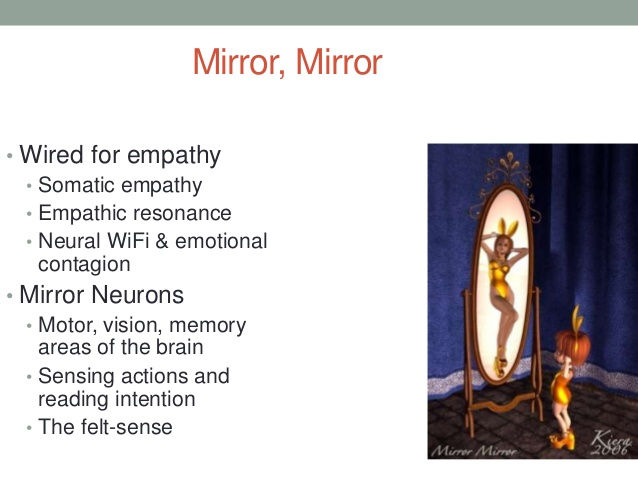
Somatic empathy is a physical reaction, probably based on mirror neuron responses, in the somatic nervous system, the part of the peripheral nervous system associated with the voluntary control of body movements via skeletal muscles.

Development
Evolutionary across species
An increasing number of studies in animal behavior and neuroscience indicate that empathy is not restricted to humans and is in fact as old as the mammals or perhaps older. Examples include dolphins saving humans from drowning or from shark attacks. Professor Tom White suggests that reports of cetaceans having three times as many spindle cells — the nerve cells that convey empathy — in their brains as we do might mean these highly social animals have a great awareness of one another's feelings.
A multitude of behaviors has been observed in primates — both in captivity and in the wild, and in particular in bonobos, which are reported as the most empathetic of all the primates. A recent study has demonstrated prosocial behavior elicited by empathy in rodents.
Rodents have been shown to demonstrate empathy for cagemates — but not strangers — in pain. For University of Chicago neurobiologist Jean Decety, empathy is not specific to humans. He argues that there is strong evidence that empathy has deep evolutionary, biochemical and neurological underpinnings, and that even the most advanced forms of empathy in humans are built on more basic forms and remain connected to core mechanisms associated with affective communication, social attachment and parental care.

Ontogenetic development
By the age of two years, children normally begin to display the fundamental behaviors of empathy by having an emotional response that corresponds with another person's emotional state. Even earlier, at one year of age, infants have some rudiments of empathy, in the sense that they understand that, just like their own actions, other people's actions have goals. Sometimes, toddlers will comfort others or show concern for them at as early an age as two. Also during the second year, toddlers will play games of falsehood or "pretend" in an effort to fool others, and this requires that the child know what others believe before he or she can manipulate those beliefs. In order to develop these traits, it is essential to expose your child to face-to-face interactions and opportunities and lead them away from a sedentary lifestyle.

According to researchers at the University of Chicago who used functional magnetic resonance imaging or MRI, children between the ages of seven and 12 years appear to be naturally inclined to feel empathy for others in pain. Their findings are consistent with previous fMRI studies of pain empathy with adults. The research also found additional aspects of the brain were activated when youngsters saw another person intentionally hurt by another individual, including regions involved in moral reasoning.
Despite being able to show some signs of empathy, including attempting to comfort a crying baby, from as early as 18 months to two years, most children do not show a fully fledged theory of mind until around the age of four. Theory of mind involves the ability to understand that other people may have beliefs that are different from one's own and is thought to involve the cognitive component of empathy. Children usually become capable of passing "false belief" tasks, considered to be a test for a theory of mind, around the age of four. Individuals with autism often find using a theory of mind very difficult.

Empathetic maturity is a cognitive structural theory developed at the Yale University School of Nursing and addresses how adults conceive or understand the personhood of patients. The theory, first applied to nurses and since applied to other professions, postulates three levels that have the properties of cognitive structures. The third and highest level is held to be a meta-ethical theory of the moral structure of care. Those adults operating with level-III understanding synthesize systems of justice and care-based ethics.

Individual differences
Empathy in the broadest sense refers to a reaction of one individual to another's emotional state. Recent years have seen increased movement toward the idea that empathy occurs from motor neuron imitation. It cannot be said that empathy is a single unipolar construct but rather a set of constructs. In essence, not every individual responds equally and uniformly the same to various circumstances. The empathic concern scale assesses "other-oriented" feelings of sympathy and concern and the personal distress scale measures "self-oriented" feelings of personal anxiety and unease. The combination of these scales helps reveal those that might not be classified as empathetic and expands the narrow definition of empathy. Using this approach, we can enlarge the basis of what it means to possess empathetic qualities and create a multi-faceted definition.
Behavioral and neuroimaging research show that two underlying facets of the personality dimensions extraversion and agreeableness — the warmth-altruistic personality profile — are associated with empathic accuracy and increased brain activity in two brain regions important for empathic processing.

Gender differences
The literature commonly indicates that females tend to have more cognitive empathy than males. Reviews, meta-analysis and studies of physiological measures, behavioral tests, and brain neuroimaging, however, have revealed some mixed findings. Whereas some experimental and neuropsychological measures show no reliable sex effect, self-report data consistently indicates greater empathy in females. On average, female subjects score higher than males on the Empathy Quotient or EQ — based on a definition of empathy that includes cognition and affect — while males tend to score higher on the Systemizing Quotient or SQ, which classifies individuals based on abilities in empathic thinking and systematic thinking. It attempts to explain the social and communication symptoms in autism spectrum disorders as deficits and delays in empathy combined with intact or superior systemizing. Both males and females with autistic spectrum disorders usually score lower on the EQ and higher on SQ. Studies found that female participants tended to score higher on empathy self-report dispositional measures and that these measures positively correlated with the physiological response. Other studies show no significant difference, and instead suggest that gender differences are the result of motivational differences.

Environmental influences
The environment has been another interesting topic of study. Many theorize that environmental factors — such as parenting style and relationships — play a significant role in the development of empathy in children.
Empathy promotes pro social relationships, helps mediate aggression and allows us to relate to others, all of which make empathy an important emotion among children. A study done by Caroline Tisot looked at how a variety of environmental factors affected the development of empathy in young children. Parenting style, parent empathy and prior social experiences were looked at. The children participating in the study were asked to complete an effective empathy measure, while the children's parents completed the Parenting Practices Questionnaire — which assesses parenting style — and the Balanced Emotional Empathy scale.

This study found that a few parenting practices — as opposed to parenting style as a whole — contributed to the development of empathy in children. These practices include encouraging the child to imagine the perspectives of others and teaching the child to reflect on his or her own feelings. The results also show that the development of empathy varied based on the gender of the child and parent. Paternal warmth was found to be significantly important, and was positively related to empathy within children, especially in boys. However, maternal warmth was negatively related to empathy within children, especially in girls.
It has also been found that empathy can be disrupted due to trauma in the brain such as a stroke. In most cases empathy is usually impaired if a lesion or stroke occurs on the right side of the brain. Damage to the frontal lobe — which is primarily responsible for emotional regulation — can impact profoundly on a person's capacity to experience empathy toward another individual.

Empathic anger and distress
Anger
Empathic anger is an emotion, a form of empathic distress. Empathic anger is felt in a situation where someone else is being hurt by another person or thing. It is possible to see this form of anger as a pro-social emotion.
Empathic anger has direct effects on both helping and punishing desires. Empathic anger can be divided into two sub-categories: trait empathic anger and state empathic anger.
The relationship between empathy and anger response towards another person has also been investigated, with two studies basically finding that the higher a person's perspective taking ability, the less angry they were in response to a provocation. Empathic concern did not, however, significantly predict anger response, and higher personal distress was associated with increased anger.

Distress
Empathic distress is feeling the perceived pain of another person. This feeling can be transformed into empathic anger, feelings of injustice or guilt. These emotions can be perceived as pro-social, and some say they can be seen as motives for moral behavior.


Comments