
Monday, September 21, 2020 – Gestures
- Mary Reed

- Sep 22, 2020
- 9 min read

I walk on a street of mostly two-story homes. It is 7:30 a.m. Suddenly, a woman drives up in a driveway and bolts out of her car, while talking on the phone and gesturing wildly. She even gestures while trying to retrieve her keys and unlock the door. Obviously, she was trying to get her point across. Why do we do that? Why do we make elaborate gestures while speaking even if no one is watching? I think it is common no matter what language you speak. Do you know some people who gesture more than others? Let’s explore the world of gestures.

According to Arika Okrent’s article “Why Do We Gesture When We Talk?” at mentalfloss.com, gesture researchers have spent the past 40 years uncovering how movements — like a cupped hand rotating in space or a finger tracing a path through the air — are intimately tied to speech. Regardless of their spoken language or culture, humans gesture when they talk. They gesture even if they have never seen gestures before; people who have been blind since birth do it. And, they gesture even if they’re talking to someone on the phone and know no one can see them. When speech is disrupted — by stuttering, for example — so is gesture.

In fact, gesture is so tightly bound to language that differences between languages show up as subtle differences in gesture. Whether a language puts information on the verb (“He flies out” in English), or on a particle outside the verb (“He exits flying,” in Spanish) will affect where the gesture for “flying” appears. In English, it will last only for the duration of the spoken verb: flies. But in Spanish, it will spread over the whole sentence — or even multiple sentences. In other words, the way you package your thoughts into speech is also how you package them into movement.

Researchers are especially interested in the times when gestures don’t match speech. The mismatch can be a valuable window to what’s going on in the mind. Susan Goldin-Meadow, a University of Chicago psychologist, has led a decades-long investigation of so-called speech-gesture mismatches. For example, until about seven years of age, children don’t understand that if you pour a tall glass of water into a shorter, wider glass, the amount of water stays the same. They think the shorter glass contains less water. When asked to explain their reasoning, some children will say, “This one is shorter,” while gesturing that the glass is wider. That discrepancy shows they subconsciously grasp that both dimensions are important. Teachers who can spot these mismatches can tell when a student is ready to understand the relationship between height, width and volume.
When we speak, we put our thoughts into words; when we gesture, we put our thoughts into our hands. But gestures don’t just show what we’re thinking — they actually help us think. Toddlers who are encouraged to gesture tend to start producing more words. Adults involved in various problem-solving tasks do better when they are encouraged to gesture. There is something about putting ideas into motions that brings us closer to grasping what we need to grasp.

According to Wikipedia, a gesture is a form of nonverbal communication or non-vocal communication in which visible bodily actions communicate particular messages either in place of — or in conjunction with — speech. Gestures include movement of the hands, face or other parts of the body. Gestures differ from physical nonverbal communication that does not communicate specific messages, such as purely expressive displays, proxemics or human use of space or displays of joint or shared attention. Gestures allow individuals to communicate a variety of feelings and thoughts — from contempt and hostility to approval and affection — often together with body language in addition to words when they speak. Gesticulation and speech work independently of each other but join to provide emphasis and meaning.

Gesture processing takes place in areas of the brain such as Broca’s and Wernicke’s areas, which are used by speech and sign language. In fact, language is thought by some scholars to have evolved in Homo sapiens from an earlier system consisting of manual gestures.

The theory that language evolved from manual gestures — termed Gestural Theory — dates back to the work of 18th-century philosopher and priest Abbé de Condillac and was revived in 1973 by contemporary anthropologist Gordon W. Hewes as part of a discussion on the origin of language.

Research throughout the ages
Gestures have been studied throughout time from different philosophers. Marcus Fabius Quintilianus was a Roman rhetorician who studied how gesture can be used on rhetorical discourses. One of his greatest works and foundation for communication was the "Institutio Oratoria" where he explains his observations and nature of different oratories.

A study done in 1644 by John Bulwer — an English physician and early Baconian natural philosopher — wrote five works exploring human communications pertaining to gestures. Bulwer analyzed dozens of gestures and provided a guide under his book named Chirologia which focused on hand gestures. In the 19th century, Andrea De Jorio — an Italian antiquarian who considered a lot of research about body language — published an extensive account of gesture expressions.

Andrew N. Meltzoff an American psychologist internationally renown for infant and child development conducted a study in 1977 on the imitation of facial and manual gestures by newborns. The study concluded that "infants between 12 and 21 days of age can imitate the facial and manual gestures of parents". In 1992, David Mcneill, a professor of linguistics and psychology at the University of Chicago, wrote a book based on his ten years of research and concluded that "gestures do not simply form a part of what is said, but have an impact on thought itself." Meltzoff argues that gestures directly transfer thoughts into visible forms, showing that ideas and language cannot always be expressed. A peer-reviewed journal Gesture has been published since 2001 and was founded by Adam Kendon and Cornelia Müller. The International Society for Gesture Studies was founded in 2002.

Gesture has frequently been taken up by researchers in the field of dance studies and performance studies in ways that emphasize the ways they are culturally and contextually inflected. Performance scholar Carrie Noland describes gestures as "learned techniques of the body" and stresses the way gestures are embodied corporeal forms of cultural communication. But rather than just residing within one cultural context, she describes how gestures migrate across bodies and locations to create new cultural meanings and associations. She also posits how they might function as a form of "resistance to homogenization" because they are so dependent on the specification of the bodies that perform them.

Gesture has also been taken up within queer theory, ethnic studies and their intersections in performance studies, as a way to think about how the moving body gains social meaning. Joseé Esteban Muñoz uses the idea of gesture to mark a kind of refusal of finitude and certainty and links gesture to his ideas of ephemera. Muñoz specifically draws on the African American dancer and drag queen performer Kevin Aviance to articulate his interest not in what queer gestures might mean, but what they might perform. Juana María Rodríguez borrows ideas of phenomenology and draws on Noland and Muñoz to investigate how gesture functions in queer sexual practices as a way to rewrite gender and negotiate power relations. She also connects gesture to Giorgio Agamben's idea of "means without ends" to think about political projects of social justice that are incomplete, partial and legibile within culturally and socially defined spheres of meaning.

Within the field of linguistics, the most hotly contested aspect of gesture revolves around the subcategory of lexical or iconic co-speech gestures. Adam Kendon was the first to hypothesize on their purpose when he argued that lexical gestures do work to amplify or modulate the lexico-semantic content of the verbal speech with which they co-occur. However, since the late 1990s, most research has revolved around the contrasting hypothesis that lexical gestures serve a primarily cognitive purpose in aiding the process of speech production. As of 2012, there is research to suggest that lexical gesture does indeed serve a primarily communicative purpose and cognitive only secondary, but in the realm of socio-pragmatic communication, rather than lexico-semantic modification.

Categories
Humans have the ability to communicate through language, but they can also express through gestures. In particular, gestures can be transmitted through movements of body parts, face and body expressions. Researchers Goldin Meadow and Brentari D. conducted research in 2015 and concluded that communicating through sign language is no different from spoken language.
Communicative vs. informative
The first way to distinguish between categories of gesture is to differentiate between communicative gesture and informative gesture. While most gestures can be defined as possibly happening during the course of spoken utterances, the informative-communicative dichotomy focuses on intentionality of meaning and communication in co-speech gesture.

Informative (Passive Gestures)
Informative gestures are passive gestures that provide information about the speaker as a person and not about what the speaker is trying to communicate. Some movements are not purely considered gestures, however a person could perform these adapters in such way like scratching, adjusting clothing and tapping.
These gestures can occur during speech, but they may also occur independently of communication, as they are not a part of active communication. While informative gestures may communicate information about the person speaking (e.g. itchy, uncomfortable, etc.), this communication is not engaged with any language being produced by the person gesturing.

Communicative (Active Gestures)
Communicative gestures are gestures that are produced intentionally and meaningfully by a person as a way of intensifying or modifying speech produced in the vocal tract (or with the hands in the case of sign languages), even though a speaker may not be actively aware that they are producing communicative gestures. For instance, in the picture of Uncle Sam on the right, he is pointing and sending a nonverbal form of gesture by implying he wants you to join the U.S. Army. This is a form of symbolic gesture, usually used in the absence of speech. Pointing at another person with an extended finger is considered rude in many cultures.

Body language relating to gestures
Body language is a form of nonverbal communication that allows visual cues that transmit messages without speaking. Gestures are movement that are made with the body: arms, hands, facial, etc. Authors Barbara Pease and Allan Pease, of "The Definitive Book of Body Language" concluded that everyone does a shoulder shrug, a gesture signifying that the person is not comprehending what they are supposed to be understanding. Also, everyone shows the palms of both hands to show a person is not hiding anything and raises the eyebrows to indicate a greeting.
Finger gestures are commonly used in a variety of ways, from pointing at something to indicate that you want to show a person something to indicating a thumbs up to show everything is good.
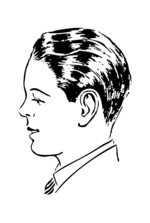
Also, in most cultures nodding your head signifies "Yes," which the book "The Definitive Book of Body Language" describes as submissive gesture to representing the conversation is going the direction of the person speaking. Interestingly, the book explains that people who are born deaf can show a form of submissive gesture to signify "Yes."

Social significance
Gesturing is probably universal; there has been no report of a community that does not gesture. Gestures are a crucial part of everyday conversation such as chatting, describing a route, negotiating prices on a market; they are ubiquitous. Gestures are learned embodied cultural practices that can function as a way to interpret ethnic, gender and sexual identity.
Gestures, commonly referred to as "body language," play an important role in industry. Proper body language etiquette in business dealings can be crucial for success. However, gestures can have different meanings according to the country in which they are expressed. In an age of global business, diplomatic cultural sensitivity has become a necessity. Gestures that we take as innocent may be seen by someone else as deeply insulting.

The following gestures are examples of proper etiquette with respect to different countries’ customs on salutations:
· In the United States, "a firm handshake, accompanied by direct eye contact, is the standard greeting. Direct eye contact in both social and business situations is very important."
· In the People’s Republic of China, "the Western custom of shaking a person's hand upon introduction has become widespread throughout the country. However, oftentimes a nod of the head or a slight bow will suffice."
· In Japan, "the act of presenting business cards is very important. When presenting, one holds the business card with both hands, grasping it between the thumbs and forefingers. The presentation is to be accompanied by a slight bow. The print on the card should point towards the person to which one is giving the card."
· In Germany, "it is impolite to shake someone's hand with your other hand in your pocket. This is seen as a sign of disrespect."
· In France, "a light, quick handshake is common. To offer a strong, pumping handshake would be considered uncultured. When one enters a room, be sure to greet each person present. A woman in France will offer her hand first."

In Hinduism and Buddhism, a mudra (Sanskrit, literally "seal") is a symbolic gesture made with the hand or fingers. Each mudra has a specific meaning, playing a central role in Hindu and Buddhist iconography. In the photo, an elderly nun in Zanskar shows a novice nun how to make the Mandala Offering Mudra.
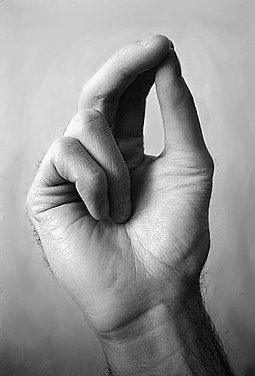
A common religious gesture includes crossing oneself in many Christian religions as a sign of respect, typically by kneeling before a sacred object in many. Gestures play a central role in religious or spiritual rituals such as the Christian sign of the cross.

Gestures are also a means to initiate a mating ritual. This may include elaborate dances and other movements. Gestures play a major role in many aspects of human life.
Gesturing is probably universal; there has been no report of a community that does not gesture. Gestures are a crucial part of everyday conversation such as chatting, describing a route, negotiating prices on a market; they are ubiquitous.
Additionally, when people use gestures, there is a certain shared background knowledge. Different cultures use similar gestures when talking about a specific action such as how we gesture the idea of drinking out of a cup.
When an individual makes a gesture, another person can understand because of recognition of the actions/shapes.

Gestures have been documented in the arts such as in Greek vase paintings, Indian miniatures or European paintings.
An example, Vitarka Vicara, the gesture of discussion and transmission of Buddhist teaching. It is done by joining the tips of the thumb and the index together, while keeping the other fingers straight.


Comments